Reliable output starts with reliable input
A perfectly formatted answer can still be wrong when it came from an outdated policy, the wrong customer record, or information the employee should not see.
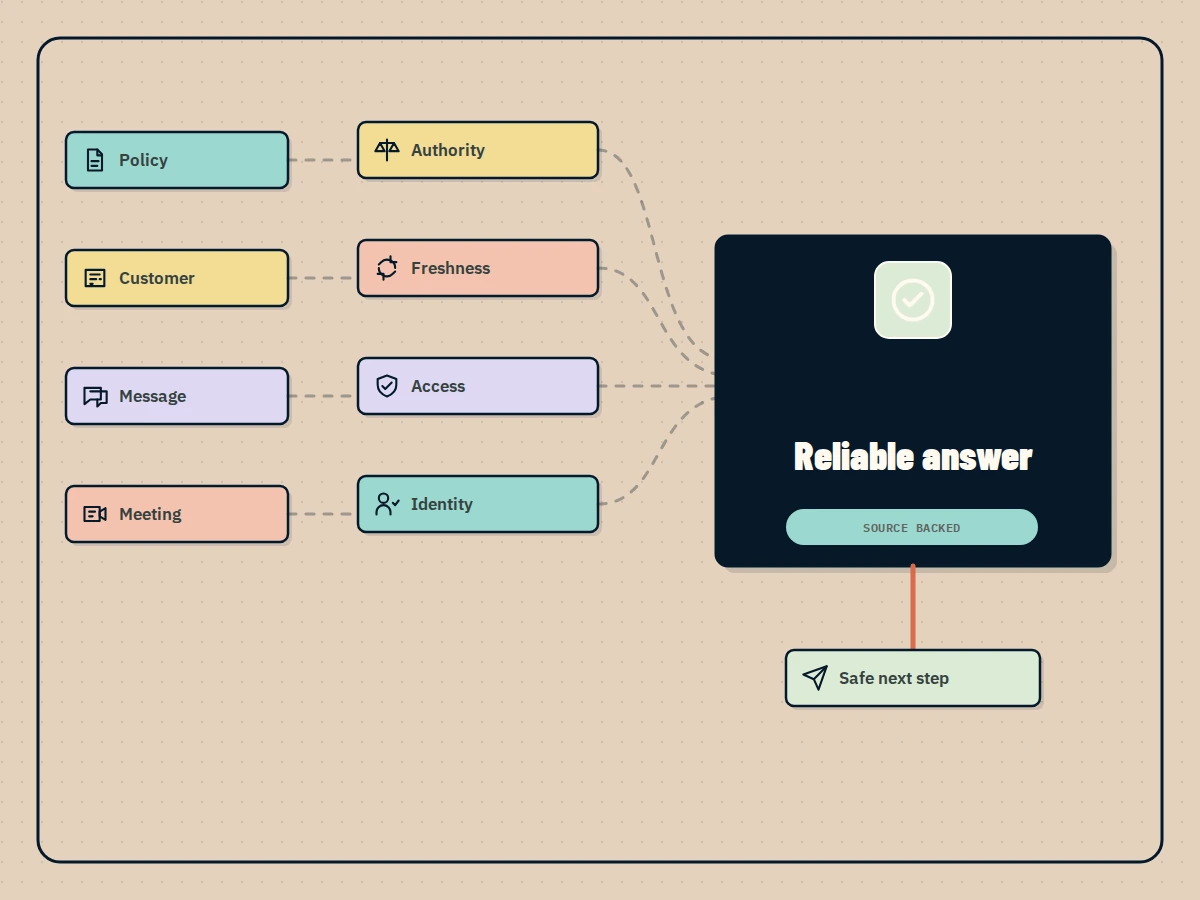
A clean answer can create false confidence.
The headings are clear. The explanation sounds certain. The action list is perfectly formatted.
The answer came from last year’s policy.
Reliability begins before the model writes the first word.
Start with source authority
Companies usually have several documents that appear to answer the same question.
There is an approved policy, an old draft, a department guide, and a Slack discussion about one exception. A text search may retrieve all four.
The system needs to know their roles.
An approved policy defines the standard. A scoped decision records an exception. A draft may provide background but should not drive the answer. An informal conversation may be evidence that needs confirmation.
Source authority should be explicit in metadata and retrieval rules, not left for the model to guess from wording.
Freshness depends on the decision
Not every source ages at the same rate.
A company history document may remain useful for years. Account ownership can change today. Inventory may change during the request. Access revocation may need to take effect immediately.
For each source, define:
- How updates are detected.
- How quickly they must appear.
- How deletions are handled.
- Who owns the source.
- When the content must be reviewed.
Show the source date in the answer when recency affects the decision. Use a live system check when the state can change faster than the index.
Permissions shape the input
The model should never receive information the employee is not allowed to use.
Filtering the final text is too late. Sensitive context may influence the answer even if the exact words are removed.
Apply access controls during retrieval. Microsoft Graph’s external item model, for example, treats the access control list as a required part of an indexed external item. The principle is broader than one platform: permission is part of the knowledge record.
Test the same question with users from different roles. The evidence set and answer should change appropriately.
Identity prevents the wrong record
Many reliability errors are identity errors.
Two customers have similar names. A project was renamed. An employee appears under several IDs. A document refers to “Atlas” without saying whether that is the internal project or the client product.
Resolve the entity before retrieving a large context set. Ask a clarifying question when ambiguity remains.
A short delay is safer than a confident answer about the wrong account.
Provenance makes correction possible
NIST guidance discusses provenance as a way to track the origin and history of information. Inside a company, provenance gives employees a practical way to verify and correct an answer.
Every material claim should link to the record, meeting, document, or message that supports it. When the answer combines sources, show the important ones rather than a vague statement that company data was used.
If an employee reports an error, the team can inspect the retrieval and repair the source, ranking rule, or identity mapping.
Without provenance, feedback becomes “the assistant was wrong.” That is difficult to fix.
Conflicts should remain visible
Suppose the handbook says refunds require finance approval, while a recent department guide says managers may approve up to a limit.
The system should not choose one silently and produce a smooth answer.
It should state that the sources conflict, show their owners and review dates, and route the inconsistency to the responsible person. Until resolved, it can use the more authoritative policy or require approval.
Uncertainty is part of a reliable system.
Test the evidence, not only the prose
An evaluation should inspect the full path:
- Was the right entity identified?
- Were only permitted sources considered?
- Did the system retrieve current, authoritative evidence?
- Were conflicts exposed?
- Did each material claim match its citation?
- Did the workflow stop when evidence was insufficient?
These tests remain useful when the model changes because they measure the company system around it.
Reliability is an operating practice
No knowledge system stays reliable by itself.
Policies change. Teams reorganize. New tools are connected. Employees correct mistakes. Review dates and evaluation cases keep the system aligned with the business.
The Business Brain is built with source backed answers, permissions, review rules, and approval boundaries because trust is not a writing style.
The output is the last step.
Reliable work begins with the evidence allowed into the room.
Questions people ask
How can a company make internal answers more reliable?
Control source authority, permissions, freshness, identity, retrieval quality, citations, and evaluation. Output formatting alone does not make an answer trustworthy.
What is data provenance?
Data provenance records where information came from and how it changed. It helps employees verify whether a claim is current, authentic, and appropriate for the decision.
Should an internal assistant answer when sources conflict?
It should expose the conflict, identify the sources and dates, and route the issue to an owner when the correct answer cannot be established safely.