A process depends on one person remembering the next step.
Business process automation services
Business process automation services built around real operations
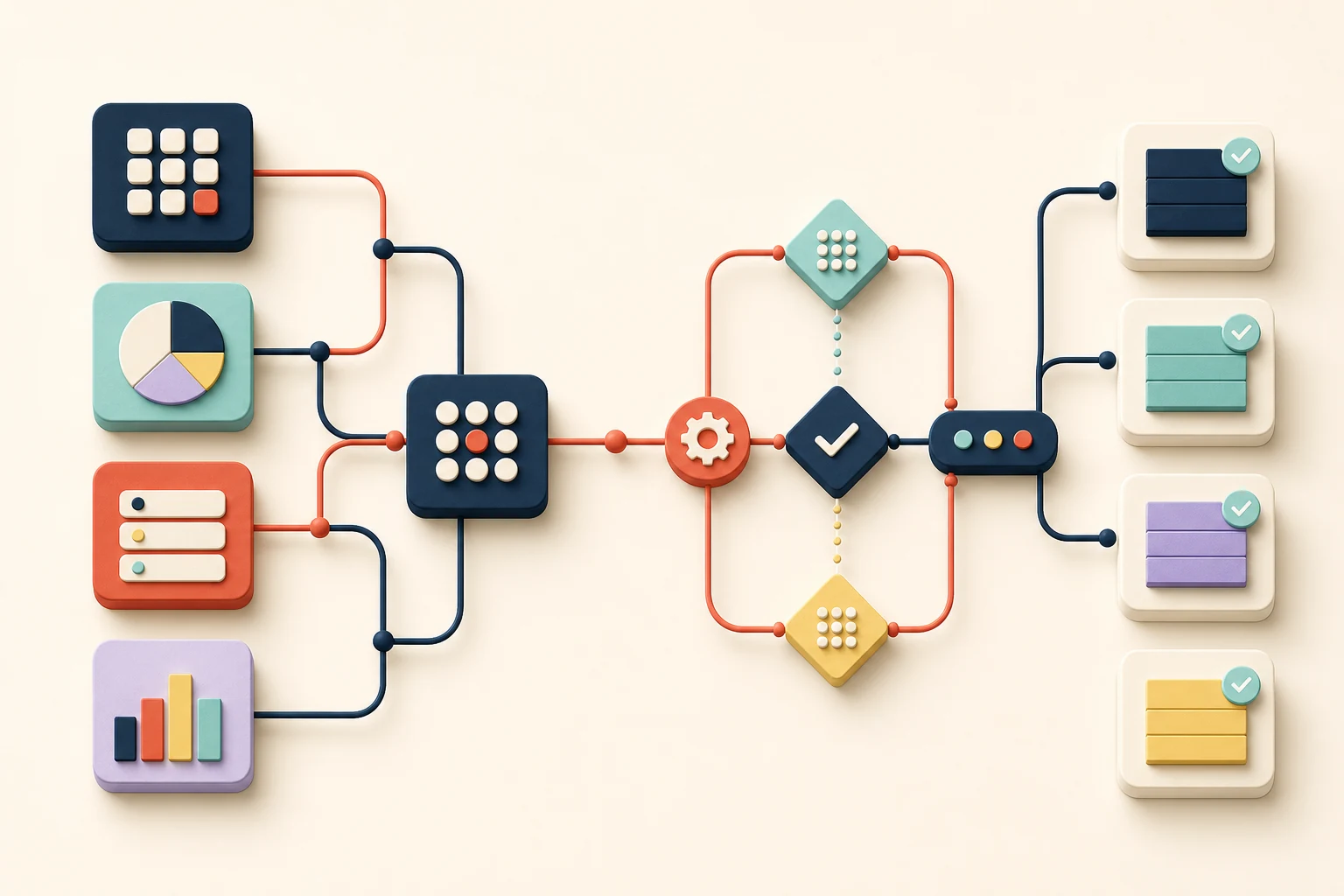
We map a repeated business process, remove unnecessary steps, and automate the handoffs that should not depend on memory. The result is a visible operating workflow with owners, rules, evidence, and recovery paths.
Focused first release · documented ownership · ongoing support available
Who this is for
A clear buyer and a defined operating problem.
For operations leaders whose teams spend material time copying data, chasing approvals, assembling reports, checking status, or repairing brittle automations between core systems.
Problem definition
Signals that the current process is costing the business.
We confirm these conditions with real examples and a baseline before recommending a build.
Teams copy the same record between CRM, spreadsheets, inboxes, and finance tools.
Approvals happen in messages without a durable audit trail.
Automations exist, but failures and ownership are unclear.
Deliverables
What the engagement can include.
The final scope is bounded to one useful outcome, with the controls required to run it after launch.
Process and exception map
A shared view of triggers, decisions, owners, data, approvals, exceptions, and completion evidence.
Workflow implementation
Reliable automations using APIs, webhooks, n8n, Make, Zapier, serverless code, or a custom service where appropriate.
Human review controls
Approval steps, confidence thresholds, escalation routes, and permissions wherever judgment or risk requires a person.
Operating visibility
Status, logs, alerts, retry controls, reconciliation, and documentation for the team that owns the process.
Engagement process
From operating evidence to a supported system.
Every step produces something reviewable. Assumptions, ownership, and failure behavior stay visible throughout delivery.
- 01
Measure the current process
Capture volume, handling time, wait time, error paths, rework, systems, and owners before choosing a tool.
- 02
Remove avoidable work
Simplify the process first so automation does not make a weak workflow run faster.
- 03
Automate one complete path
Build from a real trigger to a verifiable outcome, including the human decisions in between.
- 04
Prove failure handling
Test duplicates, bad input, third-party outages, partial updates, and manual recovery.
- 05
Improve from operating data
Compare the live result with the baseline and extend only where the evidence supports it.
Systems and integrations
Fit the new workflow into the operation you already run.
These are representative platforms and technical building blocks. The architecture is chosen from the source of truth, user journey, risk, volume, and ownership—not from a preferred logo.
Concrete outcomes
Define success before the work starts.
- Reduced handling time and repeated data entry on the chosen process.
- Shorter waits between teams because the next owner and action are explicit.
- A measurable record of completions, exceptions, retries, and approvals.
- More operating capacity without automating decisions that still need judgment.
Automation case study
One operating system for prospecting and outreach
OutreachGenie connects prospect capture, reusable audiences, visual playbooks, browser execution, pacing controls, and campaign history. The value is the continuous process across the handoffs, not one isolated action.
Read the OutreachGenie case study →- 01One reusable prospect record
- 02Visible action, wait, and condition paths
- 03Closed-loop execution and campaign history
Pricing and engagement guidance
Choose the smallest engagement that resolves the next uncertainty.
We do not publish a generic package price because integrations, data, permissions, failure handling, and ownership materially change the work. After a focused scope, you receive a clear project estimate.
Process diagnostic
A focused discovery and process-documentation engagement that establishes the current state, measured baseline, risk map, and implementation plan.
Automation sprint
For delivering one bounded process with monitoring, documentation, and a defined owner.
Automation programme
For sequencing several dependent processes across departments without creating disconnected point solutions.
Frequently asked questions
Useful answers before a first conversation.
What is business process automation?
Business process automation uses workflow rules and software integrations to move a defined process from trigger to outcome. It can coordinate data, tasks, documents, approvals, notifications, and system updates while keeping exceptions visible.
Which process should we automate first?
Start with a repeated, rule-based process that has meaningful volume, stable inputs, a clear owner, and a measurable outcome. Avoid beginning with the most politically complex or judgment-heavy process.
Do you use no-code tools or custom software?
Both. A managed tool is often right for straightforward workflows; custom code is appropriate for higher volume, complex state, strict controls, product-grade interfaces, or integrations the platform cannot express reliably.
How do you measure automation ROI?
Establish the current volume, handling time, loaded hourly cost, error or rework rate, and wait time. Compare the live process after launch, while including operating and maintenance cost rather than presenting gross time savings as guaranteed cash savings.
Can AI be part of the workflow?
Yes, when a step involves extracting, classifying, summarizing, or drafting. High-impact decisions should use defined controls, evidence, and meaningful human review.
Related evidence and guidance
Continue with the relevant detail.
Bring the business problem, not a technical specification.
We will help define the right first release, its evidence, and the systems that need to work together.