Your company now has workflow sprawl
Teams are creating prompts, assistants, and automations faster than they can maintain them. Here is how to keep useful experiments from becoming another mess.
The cost of creating an internal workflow has collapsed.
An employee can build a prompt during lunch. A team can connect a form to Slack in an afternoon. Someone creates a meeting assistant, another person creates a proposal assistant, and a third person builds a similar workflow because they never saw the first two.
This starts as useful experimentation.
Without a small amount of structure, it becomes another kind of company sprawl.
The new mess is not only documents
Companies already know what document sprawl looks like. There are five versions of the same policy, three folders called Final, and no clear owner.
Workflow sprawl has the same shape, but it can create larger consequences.
Two automations may update the same CRM field differently. An old assistant may keep using last year’s pricing. A prompt copied between departments may expose information to people who should not see it. Nobody knows whether a workflow is experimental, approved, or abandoned.
The problem is not that employees are building things. The problem is that useful work becomes invisible as soon as it spreads.
Keep an inventory before you need a cleanup project
NIST’s risk management guidance recommends maintaining an inventory of systems and defining processes for monitoring, review, and safe decommissioning. That sounds formal, but the first version can be simple.
For every workflow or assistant that reaches regular use, record:
- Its purpose.
- The person responsible for it.
- The teams using it.
- The tools and data it can access.
- The actions it can take.
- Whether actions require approval.
- The date it was last reviewed.
- Its current status: experiment, approved, limited, or retired.
This inventory does not have to slow down small experiments. It becomes necessary when a workflow touches shared data, sends external messages, changes business records, or becomes part of a team’s daily work.
Ownership matters more than authorship
The person who creates a workflow is not always the right long term owner.
A salesperson may build the first lead routing automation because the pain is obvious to them. Once the workflow becomes part of the sales operation, ownership may need to move to sales operations or a technical partner.
An owner is responsible for more than fixing errors. They confirm that the process still reflects how the business works. They know which change requests are safe. They can explain who uses the system and what happens if it stops.
If a workflow has no owner, it is already becoming legacy software.
Make successful work discoverable
The usual response to sprawl is tighter control. That can push experimentation into private accounts and hidden spreadsheets.
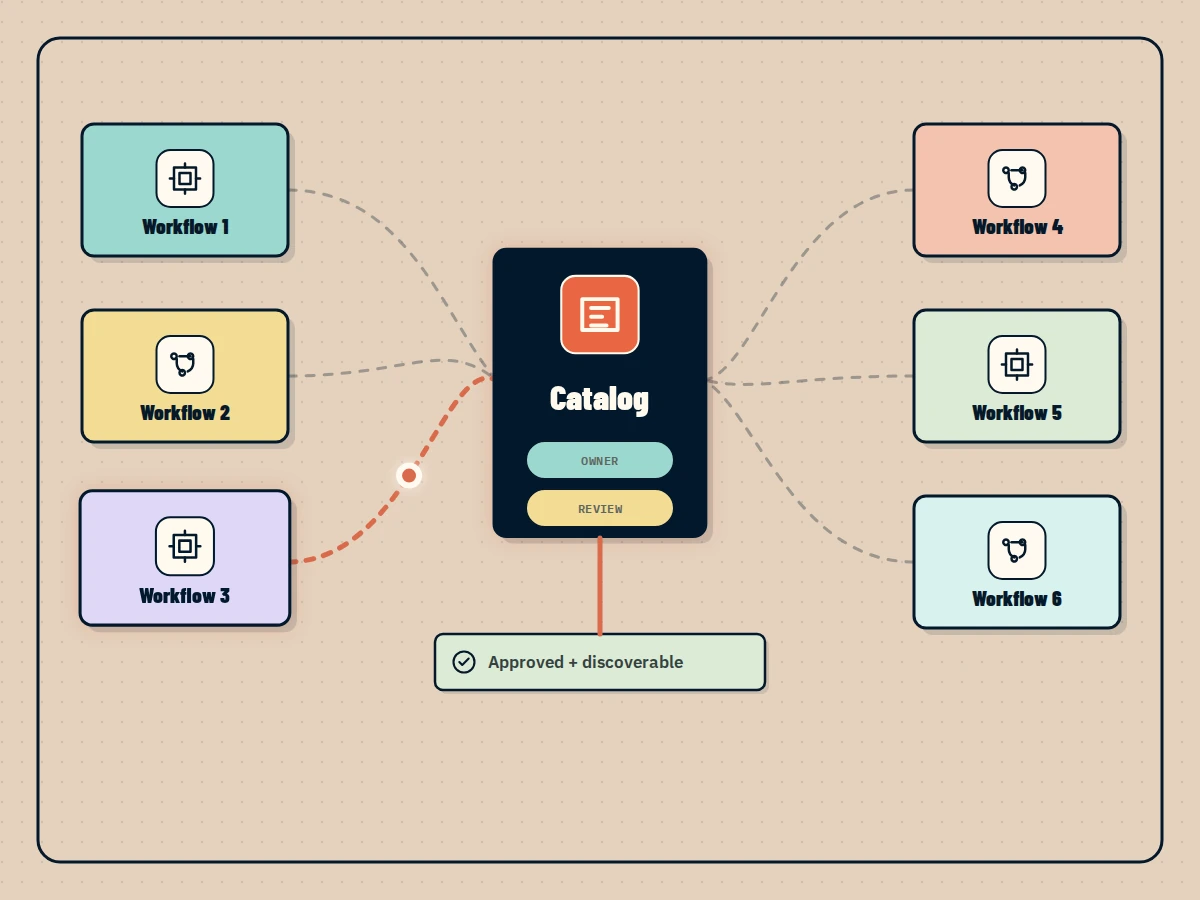
A better approach is to make approved work easy to find.
Imagine an internal catalog where an employee can search “prepare a client brief” and see:
- The approved workflow for their department.
- What sources it uses.
- A short example of the output.
- Who maintains it.
- Which clients or teams it may be used with.
- How to request a change.
Discovery prevents duplication. It also spreads the patterns that are already working.
Review based on consequence
Not every workflow needs the same level of governance.
A personal prompt that formats private notes has a different risk profile from an automation that emails customers or changes payment records.
A practical review model looks at:
- Data sensitivity. Does it read client, employee, financial, or confidential company information?
- Action scope. Does it only suggest, or can it change records and communicate externally?
- Reach. Is it used by one person or an entire department?
- Reversibility. Can a mistake be reviewed and undone?
- Dependence. Will important work stop if it fails?
Higher consequence systems need clearer evaluation, logs, approvals, and maintenance. Low consequence experiments can remain lightweight.
Retirement is part of the design
Teams are good at launching workflows and bad at removing them.
An unused automation may still hold credentials. An old assistant may remain visible in a shared menu. A scheduled job may keep creating duplicate records long after the process changed.
Every approved workflow should have a review date and a retirement path. Retirement includes disabling schedules, revoking credentials, preserving required logs, removing it from discovery, and directing users to the replacement.
This is normal software maintenance, even when the first version took only an afternoon to build.
The Business Brain can become the catalog
A Business Brain should not only help employees find documents. It can also help them find the right company capability.
Someone asks how to prepare a weekly account review. The answer can point to the approved workflow, explain what it reads, identify the owner, and show when it was last reviewed. If the employee lacks access, the system should say so instead of revealing the workflow’s private inputs.
The goal is not to centralize every experiment before it begins.
The goal is to stop the company from paying for the same idea five times, trusting a workflow nobody owns, or discovering too late that yesterday’s useful shortcut became today’s operational risk.
Questions people ask
What is workflow sprawl?
Workflow sprawl happens when teams create overlapping prompts, assistants, agents, and automations without a shared inventory, clear owners, access rules, or maintenance process.
How should a company govern internal agents?
Keep an inventory with an owner, purpose, connected tools, permissions, users, review date, and status for each system. Evaluate higher risk workflows more often and retire unused ones.
Should employees stop creating their own automations?
No. Local experimentation is useful. The company needs a simple path for successful experiments to become discoverable, reviewed, supported, and safe for wider use.