Your company should own its context
Models and software vendors can change. Your permissions, company memory, decision history, and operational knowledge should remain under your control.
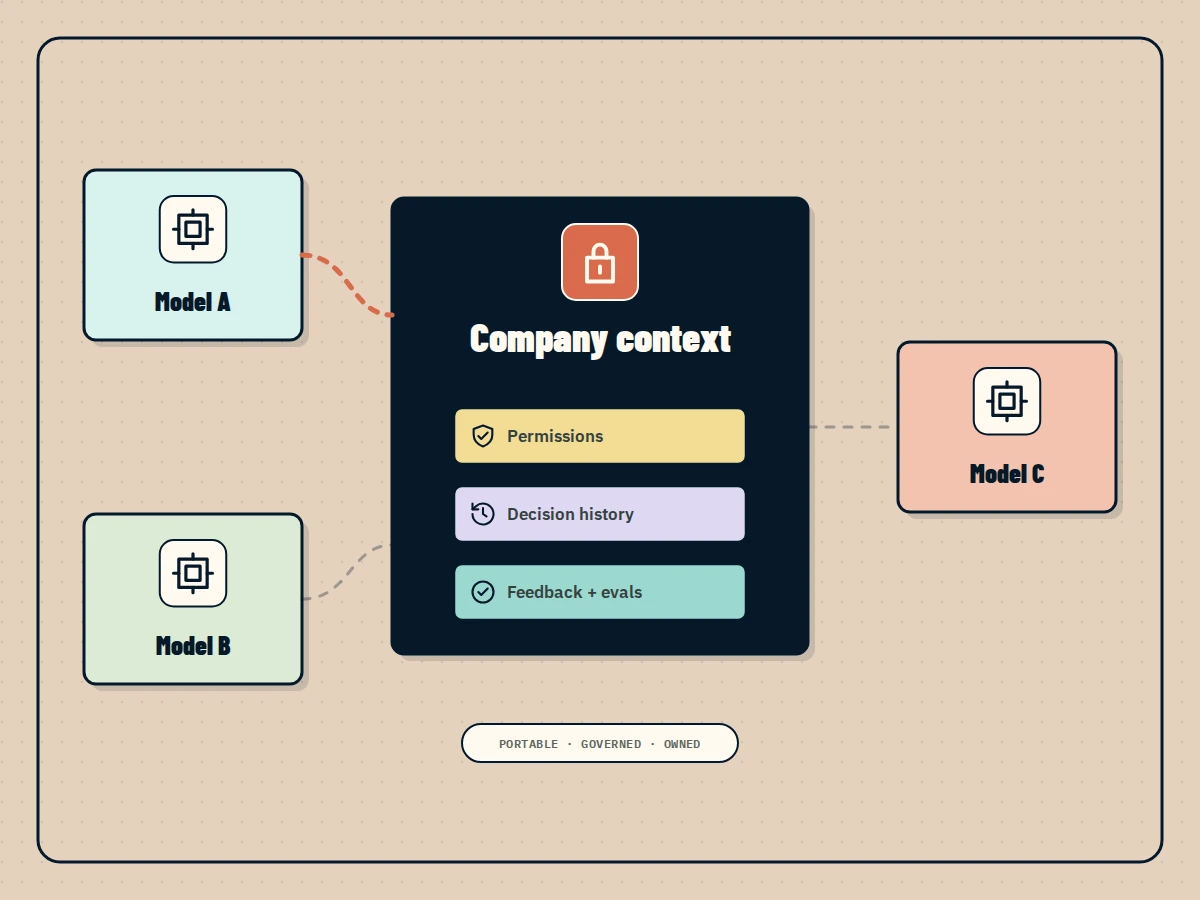
The useful part of a company assistant is not only the model answering the question.
It is everything the company has built around that answer: approved sources, access rules, customer history, vocabulary, decisions, corrections, and working procedures.
That layer becomes more valuable as employees use it and the business changes.
The company should own it.
The model is only one component
A model can read text, reason about a request, and produce an answer. It does not arrive knowing which version of your policy is approved, which Slack channel belongs to a client, or who may access a financial record.
Your system provides that context.
It decides what to retrieve, what to exclude, which tool can be called, whether an action needs approval, and what evidence appears with the result.
If all of those decisions are tightly coupled to one vendor, changing the model later becomes a migration of the company’s operating knowledge.
That is avoidable.
Separate company context from model access
A durable architecture has clear boundaries.
The company sources remain the systems of record. A governed context layer synchronizes or retrieves approved information, preserves identities and permissions, and prepares relevant evidence for a task. An action layer exposes limited tools with approval rules. The model sits above those layers as an interface and reasoning component.
This separation creates options.
One team may use Claude for complex research. Another approved model may handle a narrow classification task. A local model may be preferred for a sensitive workflow. The company does not have to rebuild its knowledge relationships each time.
Ownership includes the feedback loop
The first answer from an internal system will not be perfect.
An employee marks a policy as outdated. A manager identifies the correct owner. The team learns that a particular source should rank above an informal note. A workflow gains an approval step after a close call.
Those corrections are valuable company knowledge.
They should improve the company’s context layer rather than disappear inside a vendor interface. Store feedback with the relevant source, rule, or evaluation case. Use it to test future changes.
Over time, this feedback reflects how the company actually operates.
Permissions are part of the asset
Data ownership is often discussed as file storage. Access logic matters just as much.
The company knows which departments may see salary information, which contractors belong to which clients, and which actions require executive approval. Those rules should remain explicit, reviewable, and portable.
NIST defines data governance as the processes that formally manage enterprise data and establish authority, management, and decision parameters around it. That is a useful framing for company context too.
The question is not only “Where is the document stored?”
It is also “Who can use it, for which purpose, through which action, and with what record afterward?”
Ask these questions before choosing a platform
Before committing company knowledge to a vendor, ask:
- Can we export our indexed content, metadata, and relationships?
- Are source permissions preserved or recreated manually?
- Can we choose which models receive which information?
- What is stored in model conversation history?
- How are deletions and access revocations handled?
- Can we inspect retrieval and action logs?
- Where are employee corrections stored?
- What happens to our context if we leave?
The answers do not all need to favor self hosting. Managed services can be the practical choice. The important point is to understand where control lives.
Avoid two extremes
One extreme is to send everything directly to a model provider and trust the interface to become the knowledge system.
The other is to build every component internally before delivering any value.
Most companies need a balanced approach. Keep core context, identities, permissions, and evaluation under company control. Use managed models and infrastructure where they make sense. Make the boundaries visible in the design.
Context becomes part of company infrastructure
A working Business Brain becomes more useful when it remembers which sources are trusted, how departments relate, what customers have been promised, and how decisions turn into action.
That is not generic model capability. It is accumulated company context.
Models will improve. Vendors will change. New interfaces will appear.
Your company should be able to benefit from those changes without surrendering the memory that makes them useful.
Questions people ask
What does owning company context mean?
It means the company controls the source connections, permissions, knowledge structure, history, logs, and feedback that make its assistants useful, rather than locking that layer inside one model provider.
Can a Business Brain work with more than one model?
Yes, if the context and action layers are designed separately from the model interface. Different approved models can then use the same governed company knowledge.
How should sensitive company data be protected?
Apply least privilege access, preserve source permissions, separate credentials, log sensitive actions, require approval where needed, and define retention rules for data sent to external services.