Growth can make information harder to find
Why adding people and software can increase coordination cost, and how growing teams can keep answers, ownership, and decisions within reach.
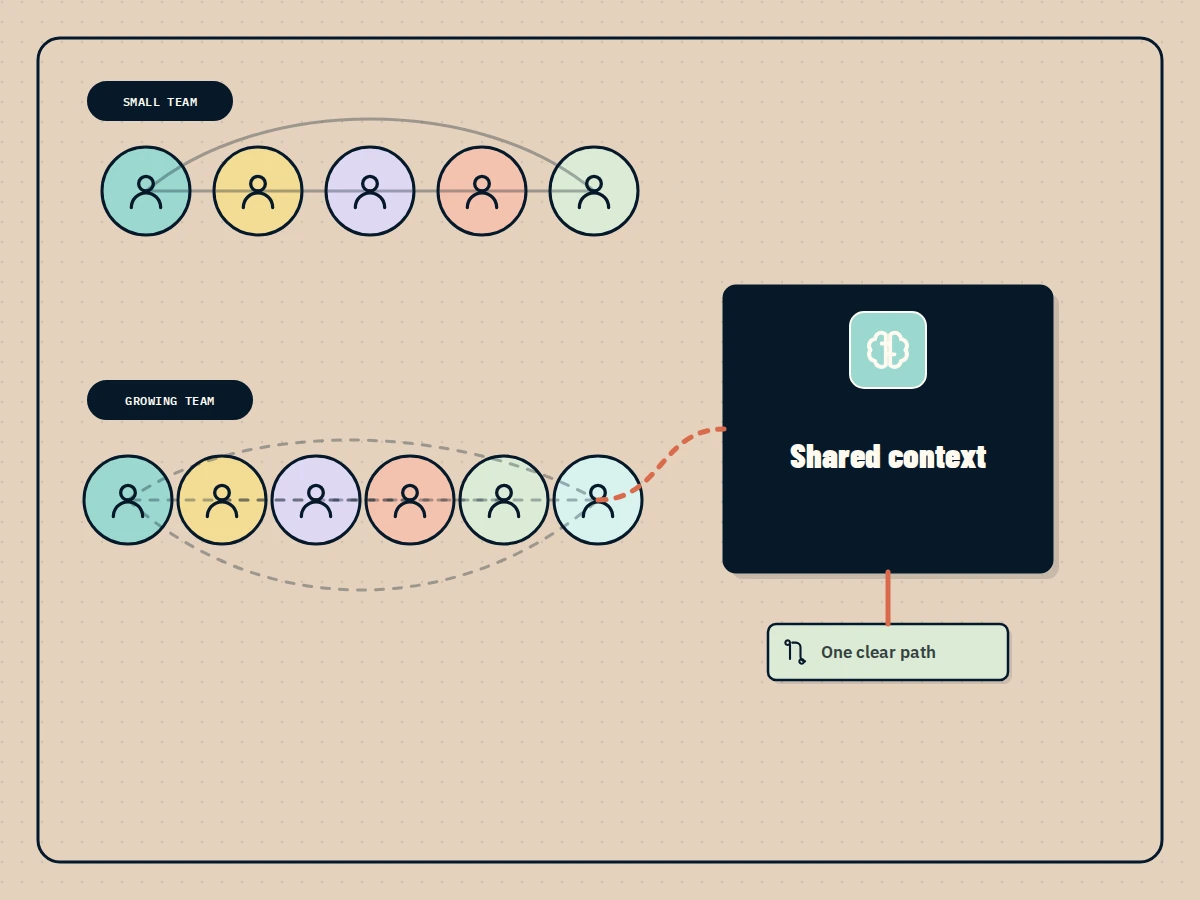
A five person team can run on memory.
Everyone knows which client is unhappy, who promised the next version, and where the latest proposal lives. Questions are answered across the room. Decisions spread through proximity.
Then the company grows.
There are more clients, more specialists, more managers, more tools, and more meetings. The company has more knowledge than before, but each person can see a smaller part of it.
This is why hiring more people does not automatically increase speed.
Growth creates more paths between people
When a team grows from five people to ten, the number of possible working relationships grows much faster than the headcount.
Nobody needs to calculate those relationships during the workday. They feel the result instead:
- More handoffs.
- More people who may own the answer.
- More places where a decision could have been recorded.
- More meetings required to keep teams aligned.
- More time spent explaining the same background.
The old informal system has reached its limit, but the company often responds by adding another communication channel or project tool. That creates one more place to check.
Information becomes fragmented by function
Sales understands the customer promise. Delivery understands the technical constraint. Finance understands the contract exception. Support sees the repeated complaint.
Each view is correct and incomplete.
The customer does not experience four departments. They experience one company. When those views are not connected, work slows at the boundary between teams.
A project manager asks why a deadline changed. The project tool shows the new date, but the reason lives in a sales meeting. Sales remembers the customer agreed, but delivery never saw the note. Leadership receives a status report after the delay has already become a problem.
The issue is not communication effort. People may be communicating constantly. The issue is that the pieces do not become shared operational context.
Search time is only part of the cost
The visible cost is the time spent looking for a document.
The larger cost is reconstruction.
An employee finds three files and still needs to ask which one is current. They read a Slack thread and still do not know what was decided. They find the task but not the customer commitment that created it. Eventually they schedule a meeting with the person who remembers.
That meeting interrupts two people. The answer remains in conversation. The same question returns next week.
This is how a small knowledge gap becomes a recurring coordination tax.
Watch for these signs
Growing companies usually feel the problem before they name it.
Common signs include:
- Leadership joins operational meetings mainly to understand status.
- New employees depend on one experienced person for basic context.
- Teams create duplicate reports because they cannot find an existing one.
- The same customer history is explained from the beginning in every handoff.
- Work pauses when a particular employee is away.
- A decision is repeatedly discussed because the previous reasoning was not preserved.
- Employees ask in Slack before searching because asking feels faster.
None of these mean the team is careless. They mean the company’s knowledge system no longer matches its size.
Stable knowledge and live context need different treatment
A handbook is useful for stable information: policies, definitions, roles, and standard procedures.
Operations also depend on information that changes daily: project state, recent decisions, customer risks, unresolved questions, and ownership.
Trying to maintain all of that manually in a wiki creates another job. Ignoring it leaves the company dependent on meetings and memory.
A better system treats approved documents as one source and live operational tools as another. It can answer with the current record, the conversation that changed it, and the person responsible for what happens next.
Reduce the cost of asking
The goal is not to eliminate communication. It is to stop every useful question from becoming a search project.
Start with the questions that travel across departments:
- What has the customer been promised?
- What changed since the last review?
- Which decision is blocking delivery?
- Who owns the next action?
- What risk needs leadership attention?
Map where each part of the answer lives. Connect those sources. Preserve permissions. Return the evidence with the answer. When a decision creates work, capture the owner and action while the context is fresh.
This is the practical role of a Business Brain. It reduces the cost of moving from a question to a safe next step.
Growth should increase what the company can do. It should not make the company forget how the work gets done.
Questions people ask
Why does communication get harder as a company grows?
More people create more relationships, handoffs, tools, and decisions. Information that once moved informally becomes fragmented across teams and systems, increasing the time required to reconstruct context.
What are signs of a company knowledge problem?
Repeated questions, work waiting for one person, conflicting documents, slow onboarding, unclear ownership, and meetings used mainly to exchange status are common signs.
Can a knowledge base solve the problem?
A maintained knowledge base helps with stable information. Growing companies also need current operational context from meetings, conversations, CRM, and project systems, together with clear ownership and decision history.