More data is not more context
Why connecting more documents does not automatically help a team make better decisions, and what a useful Business Brain must understand instead.
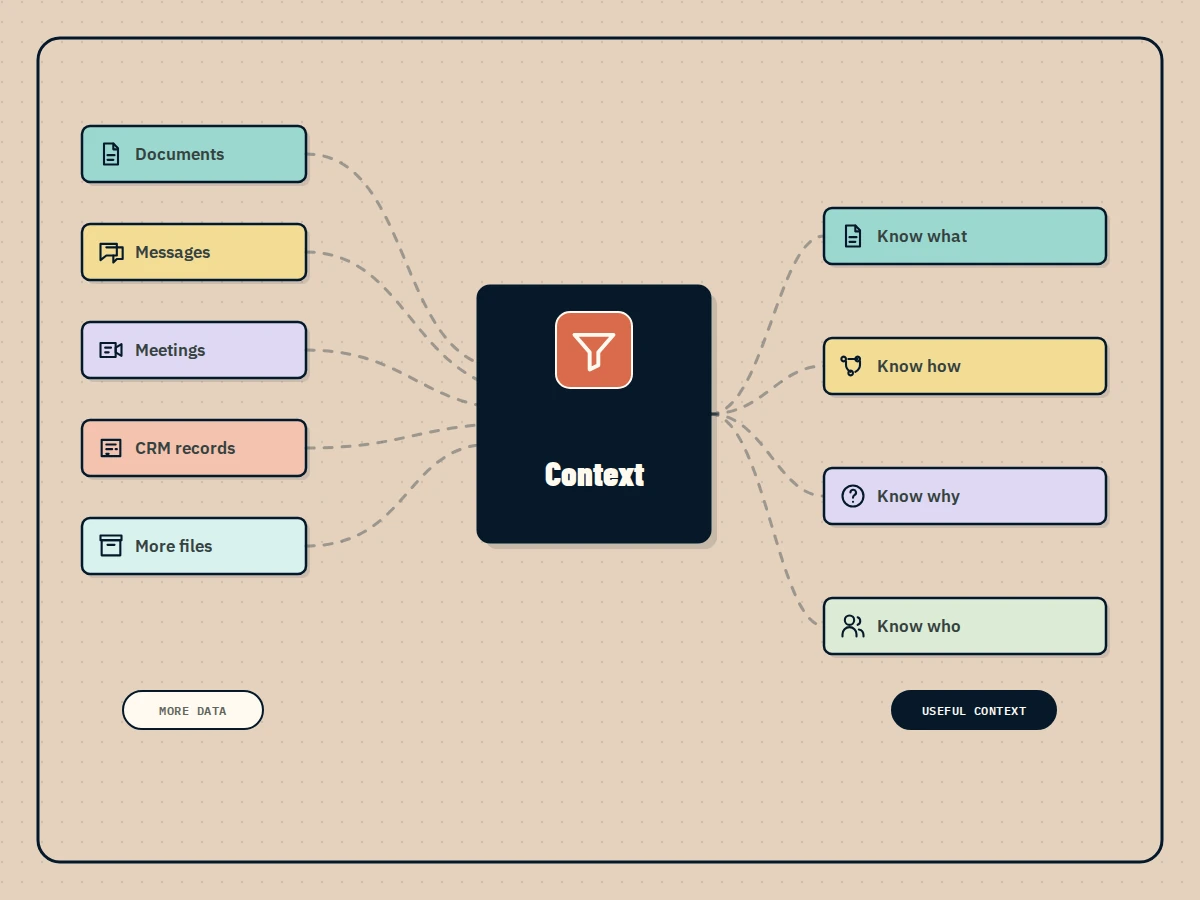
Most companies already have the answer somewhere.
It may be inside a project document, a Slack thread, a meeting recording, a CRM note, or the memory of the person who handled the same problem last year. The difficulty is not always a lack of information. The difficulty is knowing which piece matters, whether it is still true, and what the team should do with it.
This is where many internal knowledge projects go wrong. They connect more folders, import more documents, and assume the company now has more context.
It has more data. That is not the same thing.
Four kinds of knowledge exist inside a company
The OECD has used a useful distinction between four kinds of knowledge: know what, know why, know how, and know who.
You can see all four inside an ordinary client project.
Know what includes the contract, project scope, timeline, meeting notes, open tasks, and current CRM record.
Know how includes the working procedure. It explains how an escalation is handled, how a request is approved, or how the team prepares a client report.
Know why covers the reasoning behind a decision. Why was the launch delayed? Why did the team choose one supplier? Why was an exception made for this client?
Know who tells the team where expertise and responsibility live. Who owns the account? Who approved the exception? Who has solved this problem before?
A basic document search system is strongest at know what. It can find the proposal or return a policy paragraph. The other three forms are harder because they live across conversations, repeated behavior, responsibilities, and decisions over time.
That missing layer is what people usually mean when they say the answer lacks context.
A folder can contain the right answer and still produce the wrong decision
Imagine a salesperson asks, “Can we offer this customer a custom payment schedule?”
The shared drive contains a pricing policy. The CRM contains the customer history. Slack contains a conversation where finance approved a similar exception. A meeting contains the reason that exception was temporary. The current finance owner has since changed.
Returning the pricing policy alone is not enough.
A useful answer needs to establish:
- Which policy is current.
- Whether the salesperson has permission to see the financial details.
- Whether the previous exception applies to this customer.
- Who owns the approval now.
- What evidence supports the answer.
The work is not “put every document into a chatbot.” The work is connecting the question to the right records, relationships, permissions, and recent activity.
Context is assembled for a purpose
There is no single context package that works for every employee and every question.
The operations manager asking about overdue client work needs project status, recent messages, ownership, and deadlines. A new employee asking how expenses are approved needs the current policy, the actual approval path, and the right contact. Leadership asking what changed this week needs decisions, risks, client commitments, and blockers.
The source material overlaps, but the selection rules are different.
This is why a good Business Brain starts with real questions. Before connecting everything, choose a small set of questions the system must answer well. Then identify the evidence, freshness rules, permissions, and owners required for those answers.
That creates a system that serves the operation instead of a large index nobody trusts.
What a useful context layer must do
A dependable company knowledge system needs more than ingestion.
It should preserve the permission rules from each source. It should know that Moez in Slack and Moez in the CRM are the same person. It should detect when a document changes or a record is deleted. It should distinguish the final policy from an old draft. It should connect a decision to the meeting where it happened and the task created afterward.
Microsoft’s documentation for external search content provides a practical example of this hidden work. An indexed item is not only text. It can include an access control list, structured properties, content, activity, and a synchronization strategy. Updates and deletions also need to reach the index.
Those details are not optional plumbing. They determine whether an answer is current, relevant, and safe to show.
Start with one decision, not every document
Teams often delay this work because the company has years of files and dozens of tools. They imagine a migration project that must clean everything before anybody sees value.
That is not a useful first step.
Start with one repeated question or decision that currently wastes time. For example:
- What changed on our active client projects this week?
- Which promises made in meetings still have no owner?
- What is the approved process for handling a refund?
- Who has experience with this type of customer escalation?
Connect only the sources required to answer that question. Test the answer against real examples. Check the source links. Confirm that two employees with different access receive appropriately different results.
Once that works, expand to the next question.
The useful test
When evaluating an internal knowledge tool, do not ask only how many sources it connects.
Give it a question that requires more than finding a paragraph. Ask it who owns the next step, what changed recently, why the team made the decision, and where the evidence came from.
If it can only return a document, it has found information.
If it can help the right person understand the situation and continue the work, it has context.
The LeanOrchestr Business Brain is built around that second outcome. It connects approved company sources, preserves access rules, and turns the answer into a useful next step.
Questions people ask
What is business context?
Business context is the combination of facts, working methods, decision reasons, ownership, permissions, and recent activity needed to understand a question correctly. It is more specific and useful than simply having access to more files.
Why is a document search tool not enough?
Search can locate a file, but it may not explain whether the file is current, who owns the next step, why a decision was made, or how the team normally handles the situation. Those relationships must be captured as part of the system.
What should a Business Brain connect first?
Start with a small set of sources tied to one valuable question or workflow. Common starting points include Slack, meetings, a document store, CRM records, and the project system used by the team.