Build a Business Brain for real estate and construction
Connect deals, projects, properties, Asana, Slack, and Discord into one operating view with useful morning briefs and clear next actions.
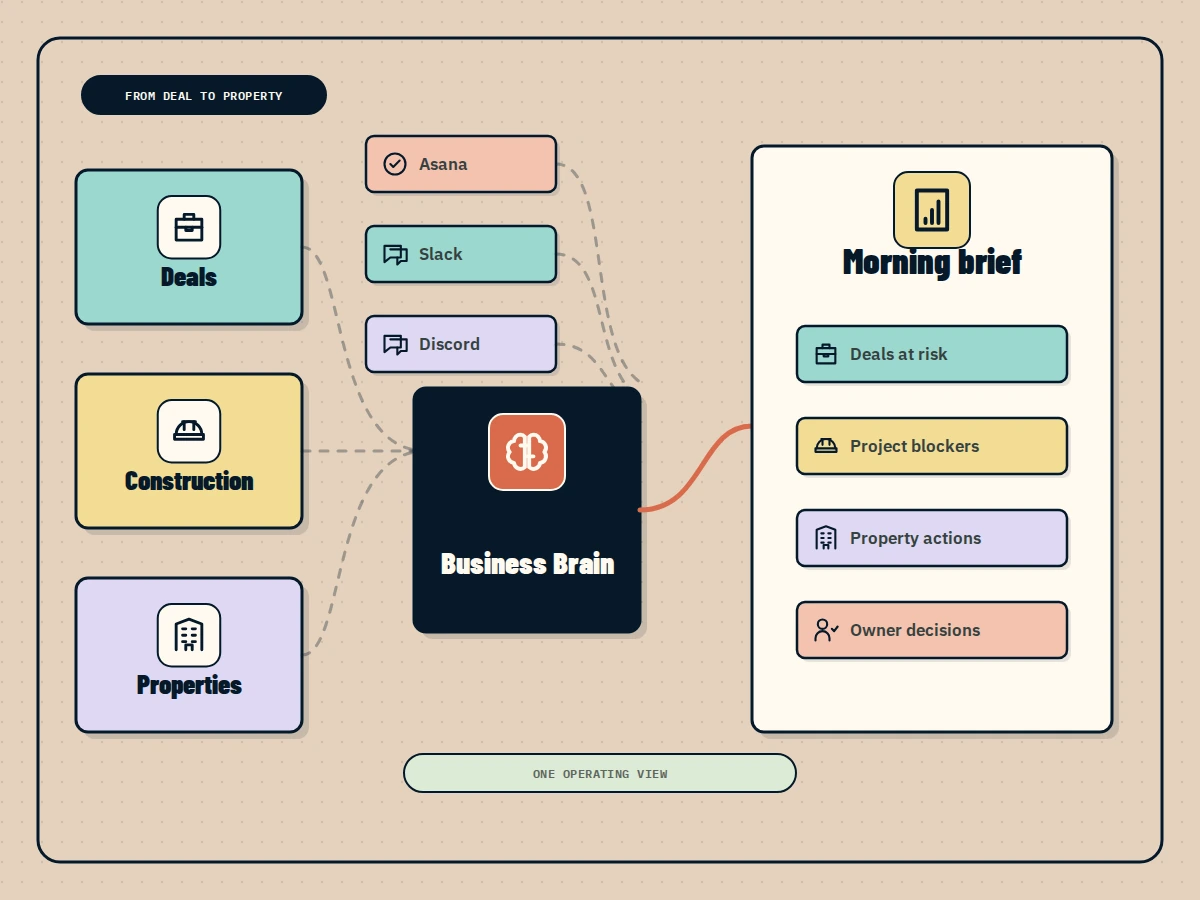
Real estate companies rarely have an information shortage.
They have a coordination problem.
The acquisitions team has the underwriting model and due diligence list. The construction team has the schedule, RFIs, submittals, and change orders. Leasing knows which prospects are serious. Property management knows which tenant issue is getting worse. Asset management has the business plan and the owner report.
All of that may be correct, but it lives in different places.
A deal can lose a week because a condition from the investment committee never became a task. A permit delay can sit in Slack while the Asana milestone still looks green. A recurring maintenance problem can remain a property management issue even after it starts affecting tenant retention and the asset plan.
A Business Brain connects those signals to the deal, project, property, and decision they belong to. It gives the company one place to ask what is happening, see the supporting evidence, and decide what should happen next.
The portfolio is one business, but the information is split by property
Every asset develops its own collection of folders, channels, projects, reports, and conversations.
During acquisition, the team is working through the LOI, purchase agreement, financing, due diligence, investment committee conditions, and closing checklist.
During development or repositioning, attention moves to design, permits, RFIs, submittals, procurement, the critical path, change orders, inspections, draws, and handover.
Once the property is operating, the daily language changes again. The team is looking at occupancy, leasing activity, arrears, renewals, work orders, vendor performance, inspections, tenant issues, operating expenses, and capital projects.
Asset management sits across all of it, asking whether the property is following the business plan and what will affect NOI, valuation, refinancing, or disposition.
The Business Brain should understand that these are not disconnected projects. They are different chapters in the life of the same asset.
Start with the questions people ask before an owner meeting
Do not begin by connecting every file the company has. Begin with the questions that take hours to answer before an acquisition call, development meeting, or portfolio review.
For example:
- Which deals are approaching a due diligence or financing deadline?
- What changed in the underwriting after the investment committee approved the deal?
- Which construction milestones could move the opening or handover date?
- Which change orders are waiting for approval, and what is their budget impact?
- What did the general contractor commit to in the last site meeting?
- Which properties have a serious maintenance, occupancy, arrears, or vendor issue?
- Which leases expire in the next 90 days, and which renewals have no clear owner?
- Which lender, broker, contractor, or property manager commitments never became tasks?
- What requires an owner decision today?
These questions define the first version of the system. They also reveal which sources matter and which information is only noise.
Let Asana hold the work plan
Asana is useful for the work that must be assigned, scheduled, and completed.
An acquisitions team can use one project for the closing plan. A development team can track design, permits, procurement, construction milestones, dependencies, and owners. Property teams can manage capital projects, inspections, vendor transitions, or a lease-up plan. Portfolios can give leadership a view across several active projects.
The Business Brain should not replace that structure. It should make it more honest.
Suppose the superintendent reports a permit problem in Slack after a site meeting. The message matters because it affects a milestone in Asana, a construction draw, and possibly a planned tenant handover. The Business Brain can connect those facts, show the source, and propose an update for the responsible project manager to approve.
It can also find the opposite problem: a task is marked complete in Asana, but the approval or inspection that proves completion cannot be found.
Asana remains the project system. The Business Brain explains what changed around the project and helps keep the plan aligned with reality.
Slack and Discord are where exceptions surface
The formal schedule rarely tells the whole story.
The useful detail often appears in a Slack channel:
- A broker says the seller has changed the timing.
- A lender asks for one more document before credit committee.
- A project manager reports that long-lead material will arrive late.
- A property manager flags a tenant complaint that needs executive attention.
- A leasing lead explains why a prospect has gone quiet.
Slack channels can organize work by deal, property, department, or project. External channels can also include selected vendors or partners. A Business Brain can monitor approved channels for decisions, commitments, blockers, and changes without treating every message as permanent company knowledge.
Discord can play a similar role when a real estate community, investor group, broker network, development partner, or contractor network already uses it. Forum channels and threads can keep discussions organized by market, property, deal, or issue. The goal is not to force Discord into every company. It is to connect it when important work already happens there.
Private channels must stay private. A contractor should not see lender negotiations. A property manager should not automatically see investor correspondence. A team member asking a question should only receive information they are allowed to access.
The morning brief should sound like a portfolio meeting
Most daily summaries fail because they report activity instead of material change.
“Twenty-seven Slack messages and eight Asana tasks were updated” is not a morning brief. It gives leadership another inbox to process.
A useful brief reads more like this:
Portfolio morning brief
Deals: The financing contingency for 18 West expires Friday. The lender requested the updated rent roll, and no owner is assigned.
Development: The electrical switchgear for Harbor Point is now expected 12 days late. The current Asana schedule still shows the original delivery date. Tenant handover may move if the sequence is not changed this week.
Property operations: Three HVAC work orders at Oak House relate to the same unit. The vendor has visited twice, but the underlying fault is still open.
Asset management: Occupancy at Ridge Center fell below the business plan after two notices. The leasing team has four active prospects and one proposal awaiting approval.
Owner decisions: Approve the Harbor Point resequencing plan. Assign the lender request for 18 West. Decide whether the Oak House repair should be treated as capex.
That brief is valuable because it connects new information to deadlines, money, ownership, and the asset plan. Every statement should link back to the message, task, document, meeting, or property record that supports it.
Keep the deal, project, and property connected
A Business Brain becomes more useful when context survives each handoff.
Acquisition and due diligence
The system connects the deal pipeline, underwriting assumptions, due diligence requests, site visits, legal questions, financing conditions, and investment committee decisions.
When an assumption changes, the team can see who changed it, why it changed, and which decision depended on the old number.
Construction and repositioning
The same asset record then connects to the project schedule, Asana tasks, site meeting notes, RFIs, submittals, change orders, inspections, and draw requirements.
If a field decision affects cost or timing, it should not disappear inside a meeting transcript or contractor message.
Handover, leasing, and property management
At handover, open defects, warranties, equipment information, vendor contacts, operating procedures, and tenant commitments move with the property. Property management should not have to reconstruct what the development team already learned.
Once the building is operating, leasing events, work orders, inspections, recurring faults, vendor issues, and tenant commitments become part of the asset history.
Asset management and reporting
Asset management can compare what is happening on the ground with the approved business plan. The Business Brain can prepare an owner brief, point to the underlying evidence, and highlight the items that need judgment.
It does not invent portfolio performance. The accounting, property management, CRM, and project systems remain authoritative for their records. The Business Brain connects those records to the decisions and operating context around them.
Property management and asset management need different views
Property management runs the building. Asset management steers the investment.
The distinction matters when the system routes information.
A failed HVAC unit begins as a property management issue. The immediate questions are whether the tenant is safe, whether a work order exists, which vendor is responsible, and when service will be restored.
If the same equipment fails repeatedly, threatens a renewal, or requires unplanned capital, it becomes an asset management issue as well. The questions change to budget impact, tenant retention, warranty responsibility, and whether the capital plan needs to change.
The Business Brain should carry the issue from one level to the other without sending every maintenance ticket to the ownership team.
Make actions reviewable
Answers are useful. Approved actions are where time is saved.
After a meeting or important conversation, the Business Brain can prepare:
- A proposed Asana task with an owner and due date.
- A proposed update to the deal or property record.
- A request for an approval.
- A follow-up message to a broker, lender, contractor, or vendor.
- An item for the next morning brief.
Material changes should be reviewed before they reach the system of record. A model should not approve a change order, change a deal stage, or alter a tenant record on its own.
The team remains accountable. The system removes the searching, copying, and repeated status chasing around the decision.
Build the first version around live assets
A practical first implementation does not need the entire portfolio.
Choose a small but representative group, such as one active acquisition, one construction or repositioning project, and one operating property. Connect:
- Their Asana projects and portfolios.
- The approved Slack channels.
- Relevant Discord forums or threads, if the team uses Discord.
- Meeting notes and selected documents.
- The deal, construction, leasing, and property records needed to answer the agreed questions.
Then define 15 to 20 questions the team currently answers by searching across systems or asking several people. Build the morning brief around material changes. Add one action workflow, such as turning an approved meeting commitment into an Asana task with the correct property, owner, and deadline.
The first version is working when the team trusts the answers, can reach the original sources, and catches issues earlier than it did before.
One operating memory for the portfolio
The value is not another dashboard.
It is continuity from deal to development, from development to handover, and from property operations to the asset plan.
Leadership gets a clear morning brief. Deal teams see deadlines and unresolved conditions. Construction teams see the decisions behind the schedule. Property managers keep operational issues moving. Asset managers understand what has changed and where they need to step in.
The LeanOrchestr Business Brain connects the tools your team already uses and builds this operating memory around your portfolio, permissions, and approval process.
Your properties can remain in separate legal entities and separate systems. The company should still be able to understand them as one business.
Questions people ask
What is a Business Brain for a real estate company?
It is a secure operating layer that connects approved information from deal files, project plans, meetings, messages, property records, and other systems. It lets the team ask portfolio questions, receive source-backed answers, and turn approved decisions into follow-up work.
Does a Business Brain replace Asana or property management software?
No. Asana can remain the system for projects, tasks, dependencies, and owners, while the property management platform remains authoritative for leases, residents, work orders, and accounting. The Business Brain connects the context around those records.
Can it connect Slack and Discord without exposing private conversations?
Yes, when access is designed correctly. Only approved channels and threads should be connected, and answers must respect the permissions of the person asking. Private deal, tenant, lender, investor, and employee information should stay restricted.
What should a real estate morning brief include?
It should focus on material changes: deals approaching a deadline, construction milestones at risk, change orders waiting for approval, leasing movement, serious property issues, overdue commitments, and decisions that need an owner.