An operating system for manufactured home dealers
Connect manufactured-home sales, land, financing, site work, factory coordination, setup, inspection, handover, and service in one operating view.
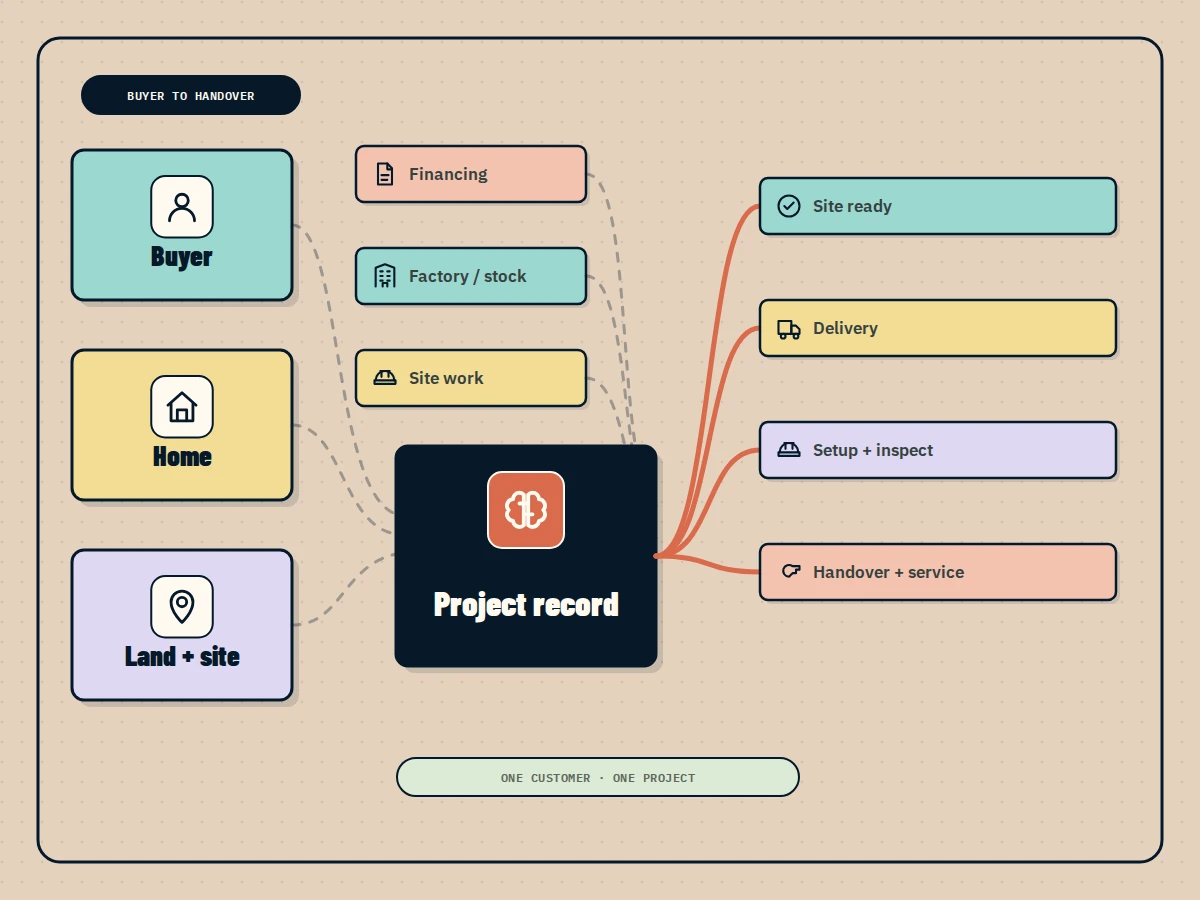
A customer choosing a floor plan feels like the center of a manufactured-home sale.
Operationally, it is only the beginning.
The home may need financing. The land may belong to the customer, a community, a developer, or another seller. The site needs to be suitable and ready. Options must match the order. Permits, utilities, foundation work, transport, setup, inspection, closing, and handover must happen in the right sequence.
The customer experiences one purchase.
The dealer coordinates a network of lenders, manufacturers, salespeople, land partners, site contractors, transporters, installers, inspectors, title professionals, local authorities, and service teams.
When those handoffs live in separate inboxes, spreadsheets, text threads, and people’s memory, the general manager becomes the person everyone calls to find out what is actually happening.
Manufactured-home sales are project delivery
A typical retail pipeline can end when the customer buys the product.
A manufactured-home transaction often becomes more operational after the contract.
The exact path depends on the home, land, financing, jurisdiction, and work included in the agreement. A dealership may handle a home-only sale, a replacement home, a placement in a community, a land-home package, or part of a larger investor or affordable-housing project.
Each path can involve a different combination of:
- Home model, floor plan, options, pricing, and inventory or factory availability.
- Customer documents and financing conditions.
- Land ownership, title, survey, zoning, site suitability, and access.
- Permits and local requirements.
- Clearing, grading, foundation, utility, driveway, drainage, septic, or other site work.
- Factory order status and home identification information.
- Transport, installer, crane, contractor, and inspector schedules.
- Setup, utility connections, inspection, closing, handover, and service.
This is why the operating system cannot be only a sales CRM. The team needs a project record that remains connected to the customer record from first inquiry through handover.
Give every home and site one shared project record
The shared project record should tell the team what has been sold, where it is going, what must happen before delivery, and who owns each dependency.
It can connect:
- Buyer and authorized contacts.
- Sales representative and operations owner.
- Home model, floor plan, options, price, and approved changes.
- Inventory unit or factory order.
- Serial and certification-label information when available and appropriate.
- Land or community details.
- Financing path and outstanding conditions.
- Site assessment, scope, permits, and readiness evidence.
- Manufacturer, transporter, installer, contractors, and inspector.
- Delivery window, setup sequence, inspection, and handover.
- Customer commitments, service items, and source documents.
Sensitive customer and finance information should remain in the system designed to hold it. The operating record can show that a requirement is complete without exposing private documents to every contractor or salesperson.
When the general manager asks about the Wilson home, the answer should show the latest approved model, finance status, site readiness, delivery risk, next action, and supporting source.
Separate the project paths early
One generic checklist creates confusion because not every manufactured-home deal is the same.
The project should branch as soon as the team understands the transaction.
Home-only sale
The buyer already has an approved destination and is responsible for some or all site and installation arrangements. The dealer still needs clear proof of responsibilities, delivery requirements, and what is included in the sale.
Replacement home
The existing home, site access, disconnection, removal, utilities, foundation, and timing may affect the new delivery. The plan must show which work belongs to the dealer, customer, installer, or another contractor.
Community placement
The community may have its own approval, lot, model, skirting, utility, access, or scheduling requirements. Those conditions should become visible project dependencies.
Land-home package
The land, home, financing, site work, permits, utilities, and closing must stay synchronized. A delay in one path can stop all the others.
Investor or development project
Several homes may share a site plan, contractor, lender, factory schedule, and inspection sequence. Leadership needs both the unit-level record and the program-level view.
The team should not rely on one salesperson remembering which checklist applies.
Use entry and exit criteria for each stage
Stages become trustworthy when they represent completed conditions rather than optimism.
Inquiry to qualified buyer
The lead has an owner. The team understands the desired home, location, timing, budget range, land situation, and likely financing path. Important unknowns are visible.
Qualified to home and site match
The proposed model and options fit the customer’s needs, approved sales process, destination, and known site constraints. Any required site review has an owner.
Home and site match to contract
Pricing, included work, exclusions, options, responsibilities, and required notices are approved and documented. The customer should not receive one promise from sales and a different interpretation from operations.
Contract to site ready
The required land, permit, access, foundation, utility, contractor, and inspection conditions for that project path are complete or scheduled with evidence. “Site ready” should be a defined state, not a message saying someone thinks it looks fine.
Site ready to delivery and setup
The correct home is available, the destination is ready, transport and installation resources are confirmed, and the sequence is coordinated. A delivery date should not be treated as firm while a critical dependency remains open.
Setup to inspection and handover
Required installation work, inspection, closing items, manuals, customer orientation, open defects, and service responsibilities are recorded. The handover package follows the home rather than remaining in several inboxes.
These criteria should be adapted to the state, local jurisdiction, transaction, contracts, and professional guidance. The operating system supports compliance. It does not replace it.
The hardest failures happen between companies
The dealer controls only part of the transaction. That makes external handoffs especially important.
Sales to operations
Operations receives a signed contract but not the details discussed with the buyer. A verbal promise about timing, options, site work, or responsibility appears later as a dispute.
Financing to project scheduling
The sales team hears that financing is moving. Operations treats the project as ready. A missing condition then stops the order, closing, or delivery plan.
Site contractor to transport and installer
The site contractor reports completion in a text message. The delivery team does not receive the proof it needs. Equipment and crews are scheduled around an assumption.
Manufacturer to dealership
An option, production, or availability change affects price, timing, site preparation, or the customer promise. The update reaches one salesperson but not the project plan.
Installation to inspection and service
The home is set, but inspection, certification, open work, homeowner documents, and service responsibility are not connected to one handover record.
HUD’s manufactured-housing programs themselves distinguish responsibilities involving manufacturers, retailers, installers, inspections, state programs, and dispute resolution. The company’s operating system needs to preserve those boundaries and show who owns each next step.
The morning brief should focus on homes at risk
Leadership does not need a list of every task completed yesterday.
It needs to know which buyer, home, site, or delivery needs attention.
Manufactured housing morning brief
New buyers: Five inquiries arrived. Four have owners. The land-home inquiry from Polk County has no financing follow-up.
Sales and finance: The selected options for the Carter home changed after pricing approval. The project record still shows the earlier configuration.
Site readiness: The Rivera site is waiting for utility confirmation. Delivery is tentatively scheduled for next week.
Factory and inventory: The home assigned to the Jackson project has a revised availability date. The customer commitment has not been updated.
Setup and inspection: Two homes are scheduled for setup. One inspection request is missing its owner.
Management decisions: Decide whether to move the Rivera delivery window. Approve the customer response for the Jackson schedule change.
This brief gives the general manager an exception list, not another dashboard to interpret. Each item should link to the project record and source.
Connect the CRM to the delivery plan
The dealership CRM should remain useful for lead source, salesperson, customer communication, appointment, quote, and sales stage.
The project-management system should own tasks, dependencies, owners, due dates, and repeatable delivery checklists.
The document system should hold approved contracts, notices, plans, site evidence, installation information, inspections, and handover material.
Finance systems should remain authoritative for the financial records they are designed to protect.
The Business Brain connects the context around these records.
It can answer questions such as:
- Which contracted homes do not have a confirmed site-readiness owner?
- Which delivery dates depend on incomplete permits or utilities?
- What changed after the customer approved the home configuration?
- Which projects are waiting on the manufacturer, installer, inspector, lender, or customer?
- Which sales promises are not represented in the project plan?
- Which service issues could become customer or compliance problems?
- What requires the general manager today?
The answer should cite the original CRM record, message, document, task, or inspection evidence.
Automate preparation and coordination
Useful automation removes repeated coordination work without pretending the transaction is simple.
The system can:
- Route a new inquiry by market, dealership, home type, or sales territory.
- Prepare the salesperson with prior conversations and known land or financing details.
- Create the correct project template after the transaction path is approved.
- Turn contract dates and included work into proposed tasks and responsibilities.
- Flag a delivery plan that depends on incomplete site evidence.
- Prepare customer updates from approved project information.
- Surface configuration, schedule, or responsibility changes for review.
- Assemble a handover package from the project record.
- Route a service or defect report to the responsible team with a dated source trail.
The system should not approve financing, declare a site compliant, certify installation, alter a contract, or determine responsibility for a defect on its own.
Those actions belong to qualified people and the relevant regulatory, contractual, and professional process.
Keep the customer informed without making false promises
Customers usually care about a few questions:
- What happens next?
- What do you need from me?
- Who is responsible for this step?
- Is the home, land, financing, or site holding things up?
- Is the delivery date confirmed?
- Who do I contact after handover?
A connected operating record makes it easier to answer consistently.
The system can prepare a customer update when a material stage changes. A team member reviews it before sending. If a delivery date is tentative, the update should say so and name the unresolved dependency.
Fast communication matters. Accurate communication matters more.
Start with one common transaction path
Choose the path the dealership completes most often, such as a home-only sale, replacement home, community placement, or land-home package.
Map the handoffs from inquiry to service. Identify the system of record, owner, required evidence, and completion rule at each stage.
Connect the minimum useful sources:
- Lead forms and CRM.
- Product, inventory, or factory-order information.
- Project tasks and schedules.
- Approved customer communications.
- Contract and project documents.
- Site, delivery, installation, and inspection updates.
- Service or warranty intake.
Define 15 to 20 questions the general manager and operations team repeatedly answer by calling people. Build the morning brief. Add one workflow, such as creating the correct approved project plan after contract or flagging delivery when site-readiness evidence is incomplete.
Once the record is trusted, expand into more markets, transaction paths, locations, contractors, reports, and specialized agents.
One customer experience needs one operating picture
The buyer should not have to understand the dealership’s internal handoffs.
Sales, financing, land, site work, factory coordination, transport, setup, inspection, handover, and service may involve different companies and different systems. The dealership still needs one reliable view of the project.
The salesperson should know what can be promised. Operations should see what is ready and what is not. Contractors should receive only the information they need. The general manager should manage exceptions instead of reconstructing projects.
The LeanOrchestr Business Brain connects the existing dealership tools and builds that operating picture around each buyer, home, site, and approved responsibility.
The customer experiences one purchase. The team should be able to operate it as one project.
Questions people ask
What is an operating system for a manufactured home dealer?
It is the connected process and shared project record that moves a customer from inquiry and home selection through financing, land and site review, contracting, factory or inventory assignment, site preparation, transport, installation, inspection, handover, and service.
Does it replace the dealership CRM or project-management software?
No. The CRM can remain authoritative for the customer and sales pipeline, while the project system manages tasks and dependencies. The operating layer connects those records to documents, approvals, site information, installer and contractor updates, inspections, and customer commitments.
Can it support both home-only and land-home transactions?
Yes, if the project path branches early. A home-only sale, replacement home, community placement, and land-home package have different financing, site, title, permitting, utility, and handoff requirements. Each path needs its own checklist and approval rules.
What should a manufactured-housing morning brief include?
It should show new buyers awaiting contact, finance or document gaps, sites that are not ready, factory or inventory changes, delivery and installer conflicts, inspections due, customer commitments at risk, and decisions that require the general manager or operations lead.