How to keep home-buying deals moving to closing
A practical operating system for growing home-buying companies that need cleaner seller lead, acquisitions, title, and closing handoffs.
A motivated seller submits a form at 8:14 on Monday morning.
The notification reaches Slack. An acquisitions rep calls from their phone. Notes go into the CRM later. The appointment is booked on a calendar. Someone updates the comps in a spreadsheet. The offer is discussed in a meeting. A signed contract lands in email. The title company asks a question that only the founder knows how to answer.
By Friday, the CRM says the deal is under contract.
It does not say that the seller still has one unresolved concern, the title request has no owner, and the inspection period ends next week.
This is how a growing home-buying company can have a pipeline full of activity and still depend on the founder to keep deals moving.
The problem is not a lack of effort. It is that the deal changes across several tools without one shared operating record connecting the change, the owner, and the next action.
The breaking point arrives before the company feels large
A founder can personally hold the pipeline together when the team is small and the volume is low.
They remember which seller needs a softer follow-up. They know why an offer was structured a certain way. They recognize the address in a title email. They can answer the transaction coordinator without opening five systems.
Then the company adds an acquisitions rep, a lead manager, a transaction coordinator, an operations person, or a project manager. More leads enter from the website, paid campaigns, referrals, agents, wholesalers, and direct outreach. Several properties move at the same time.
The founder is still the person who knows how the pieces fit together, but now every broken handoff reaches them as a question.
- Did anyone call the new seller lead?
- Why did we change the offer?
- Did the seller sign the addendum?
- Who is answering the title request?
- Is this a cash purchase, assignment, joint venture, or another approved structure?
- What could stop this deal from closing?
This is the real systems trigger for a founder-led acquisitions company. The team has enough volume to need specialization, but the operating context still lives in a few people.
Treat each property as one deal record
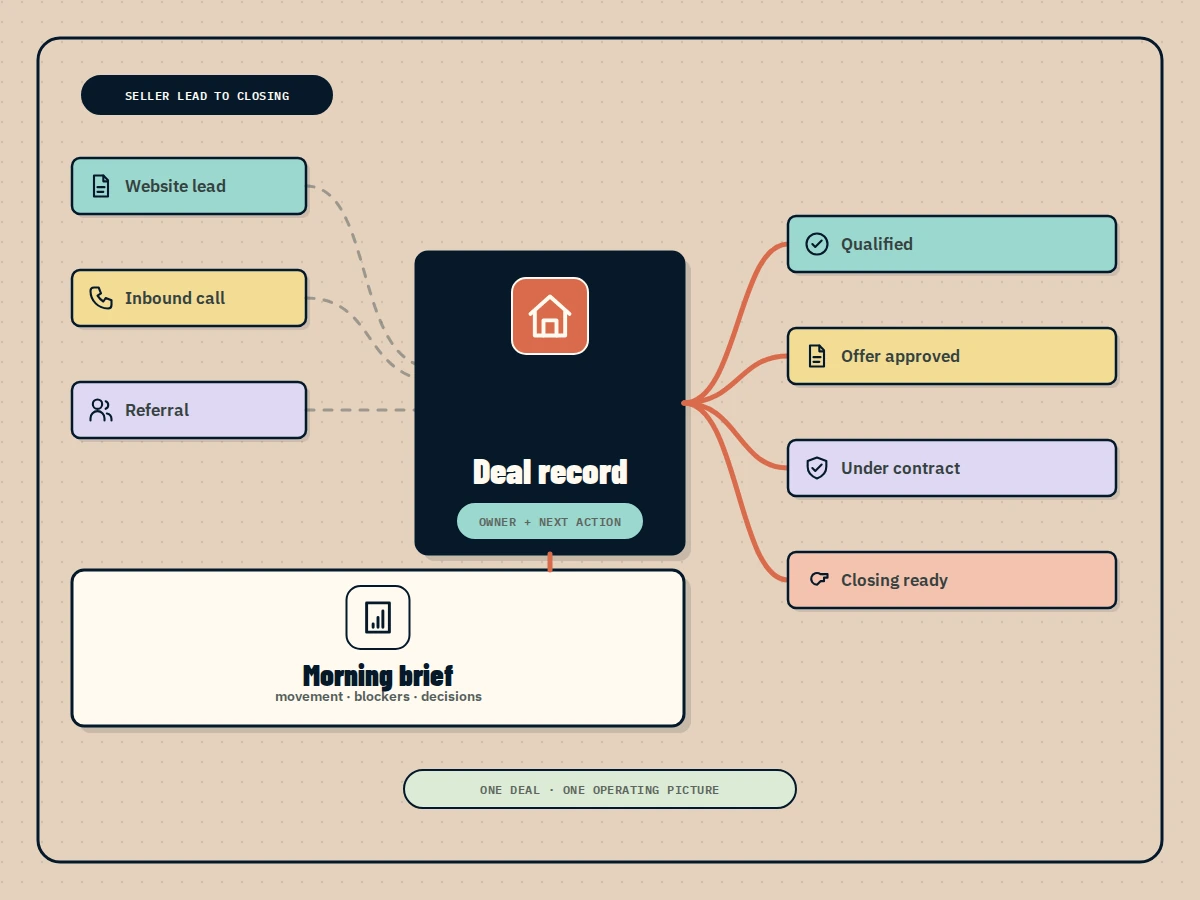
The cleanest place to start is one deal record for each property opportunity.
That record does not need to store every file and conversation. It needs to connect the information that determines what happens next:
- Property address and seller identity.
- Lead source and first-contact time.
- Seller motivation, timing, condition, occupancy, and stated constraints.
- Appointment, call, and follow-up history.
- Underwriting assumptions and the source of those assumptions.
- Approved offer strategy and approval history.
- Current stage, owner, deadline, and next action.
- Signed documents and material seller commitments.
- Title, access, inspection, financing, buyer, or closing issues.
- Chosen disposition or project path after acquisition.
The CRM can remain the system of record for the pipeline. The Business Brain connects that record to the calls, messages, documents, tasks, and decisions around it.
When someone asks what is happening at 214 Pine Street, the answer should not be a stage name. It should explain what changed, what is waiting, who owns it, and where the evidence lives.
Build the pipeline around exit criteria, not hopeful labels
Stages such as New Lead, Appointment, Offer Sent, Under Contract, and Closed are useful. They become unreliable when people move deals forward based on activity rather than evidence.
A stronger pipeline defines what must be true before a deal enters the next stage.
New lead to qualified
The lead has an assigned owner. The team has made or scheduled contact. The property and seller information needed for the next conversation is present. Duplicate leads have been resolved.
Qualified to appointment or underwriting
The team understands enough about motivation, timing, property condition, occupancy, and the seller’s situation to justify more work. Unknowns are visible rather than silently left blank.
Underwriting to offer
The relevant comps, repair assumptions, holding or transaction costs, exit assumptions, and approval are attached to the offer decision. A rep should not have to ask the founder to reconstruct why the number was chosen.
Offer to contract
The accepted terms match the approved structure. The signed documents are stored. Material commitments made during the conversation are captured. Dates and responsibilities become tasks.
Contract to closing
Title, access, inspection, funding, buyer, lender, assignment, joint-venture, or other transaction requirements have named owners and due dates. Exceptions appear before they threaten the close.
The purpose is not to add bureaucracy. It is to stop a green pipeline stage from hiding unfinished work.
Five places deals quietly lose momentum
Most lost time appears between the visible steps.
A seller response does not change the next action
The seller answers a call or text, but the outcome never changes the CRM task. The next follow-up is still generic, or no follow-up exists.
An appointment is booked without preparation
The calendar has a meeting, but the acquisitions rep does not have the lead history, property facts, open questions, or previous conversation in one place.
The offer changes without a decision trail
Someone adjusts the price or structure after a call. The latest number is saved, but the reason and approver are missing. The same debate happens again during contract or disposition.
A signed contract creates no closing plan
Getting the contract feels like the win. Then deadlines, title requests, deposits, inspections, financing, buyer communication, and seller updates depend on a transaction coordinator noticing every detail manually.
The founder becomes the exception queue
Anything unusual is forwarded to the owner without a clear question. The founder reads the full thread, finds the missing context, and decides what should have been prepared before escalation.
A good system does not remove judgment from acquisitions. It makes the judgment point visible and gives the decision-maker a complete, short brief.
The daily acquisitions brief should show movement and risk
A list of every CRM update is not useful to the founder or COO.
The morning brief should surface only the work that changed or needs attention.
Acquisitions morning brief
New seller leads: Three arrived overnight. Two have owners. The web lead for 214 Pine Street has not been contacted.
Appointments: Four are scheduled today. The Oak Avenue appointment is missing the property-condition notes requested by the acquisitions manager.
Offers: Two offers are awaiting seller response. The Maple Drive seller asked about a different closing date, but no follow-up task was created.
Under contract: The title company requested an additional document for Lake Road. The inspection period for Cedar Lane ends Thursday.
Founder decisions: Approve the revised terms for Bay Street. Choose the next step for the title issue on Lake Road.
Every item should link to the deal record and original source. The founder can see the operation without asking each person for a status update.
Use automation for the handoff, not the negotiation
Automation is useful when the rule is clear and the action is reversible.
It can:
- Capture and deduplicate website leads.
- Assign a lead based on market, source, or availability.
- Create the first call and follow-up tasks.
- Prepare an appointment brief from approved information.
- Turn an accepted meeting commitment into a proposed task.
- Start the transaction checklist when a signed contract is stored.
- Flag a deadline or title request that has no owner.
- Prepare a daily brief and link every item to its source.
It should not decide what a vulnerable seller should accept, invent property facts, approve an unusual contract structure, or change material deal terms without review.
The system prepares the work. The acquisitions team owns the relationship and the decision.
Keep every tool in a clear role
Growing teams often respond to coordination problems by replacing software. Sometimes the existing tools are already good enough. Their roles are simply unclear.
The CRM owns the seller lead, deal stage, assigned rep, and structured pipeline data.
The project-management system owns transaction tasks, dependencies, checklists, and due dates.
Email, phone, and messaging hold conversations with sellers, agents, buyers, lenders, title companies, and partners.
The document system owns signed agreements, disclosures, title material, and approved deal documents.
The accounting or transaction system owns the financial records it was designed to hold.
The Business Brain connects the operating context around those systems. It should show disagreement between sources instead of quietly guessing which one is correct.
Give each role the view it needs
The founder does not need the same interface as the lead manager.
The lead manager needs new leads, response status, follow-ups, and appointments.
The acquisitions manager needs seller context, underwriting status, offers, objections, and rep activity that requires coaching.
The transaction coordinator needs signed documents, dates, title items, deposits, inspections, funding requirements, and closing dependencies.
The project or disposition team needs the approved plan after acquisition and the history that affects it.
The founder or COO needs exceptions, pipeline movement, forecast confidence, and decisions waiting on them.
One connected deal record can support all of these views without showing every employee every private conversation or financial document.
Start with one market and one deal path
Do not begin by automating every possible transaction.
Choose one market and the deal path the company runs most often. Map what happens from a new seller lead to closing. Define the owner, required information, exit criteria, and source of truth at each step.
Then connect the smallest useful set of systems:
- Website or lead forms.
- CRM.
- Calendar and call notes.
- Email or approved messaging sources.
- Transaction tasks.
- Signed documents and title updates.
Agree on 15 to 20 questions the founder and operations team currently answer by chasing people. Build the morning brief. Add one high-value workflow, such as turning a signed contract into an approved closing checklist with owners and dates.
Expand into other markets, dispositions, financing structures, project paths, and specialized agents after the core deal record is trusted.
The founder should manage exceptions, not reconstruct deals
A growing home-buying company does not need more software screens.
It needs one reliable operating picture from seller lead to closing.
The team should know who owns the next action. The transaction coordinator should see issues before deadlines. The acquisitions manager should understand why a deal moved or stalled. The founder should receive the decision, context, and evidence without reading the entire history.
The LeanOrchestr Business Brain connects the tools already used by the acquisitions team and turns scattered deal activity into a source-backed operating system.
The founder should still make the hard calls. They should not have to rebuild the deal before making them.
Questions people ask
What is an acquisitions operating system for a home-buying company?
It is the connected process that moves a seller lead from first contact through qualification, underwriting, offer, contract, title, and closing. It defines the record, owner, required information, next action, and evidence at each stage.
Does this replace a real estate acquisitions CRM?
No. The CRM should remain authoritative for the lead and deal stage. The operating system connects it to calls, email, documents, tasks, title updates, meetings, and approvals so the stage reflects what is actually happening.
Can one system support cash, wholesale, creative-finance, and joint-venture deals?
Yes, but each path needs its own required fields, approvals, documents, and exit criteria. The system should not treat every seller lead as the same transaction or let an automated workflow choose a deal structure without review.
What belongs in a daily acquisitions brief?
It should show new leads without contact, follow-ups due, appointments needing preparation, offers awaiting a decision, contracts approaching a deadline, title or closing blockers, and the few items that require the founder or acquisitions manager.