Company memory is also knowing who knows what
Documents are only part of organizational memory. Teams also need to know where expertise lives, which source is credible, and who can move the work.
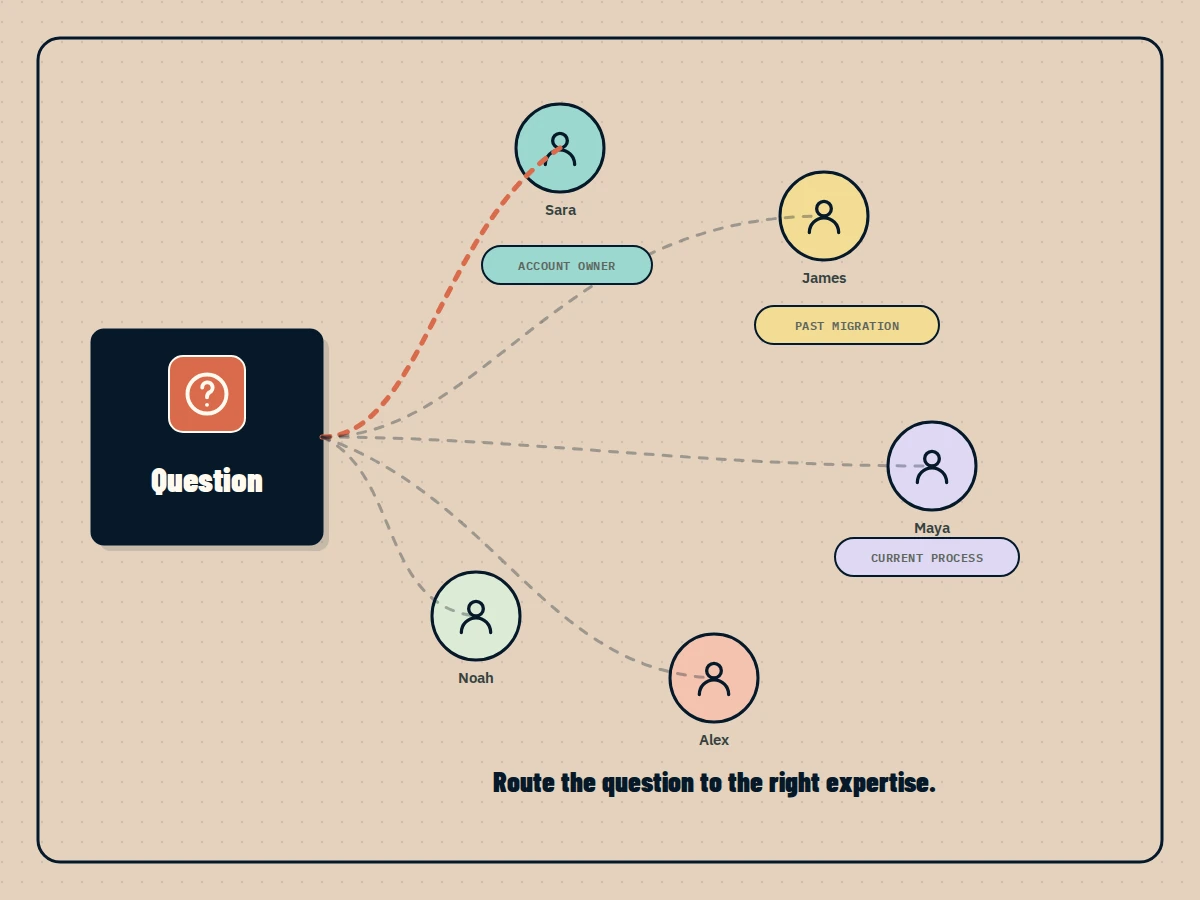
A company can save every document and still lose important knowledge.
The missing piece is often not the answer itself. It is knowing who understands the problem, which source deserves trust, and how to reach the right expertise before a decision is made.
Researchers have a name for this: transactive memory.
The practical version is simple. A good team knows who knows what.
Teams store knowledge across people
No employee needs to remember everything.
One person understands a difficult customer. Another knows the reporting pipeline. Someone else remembers why the company changed its pricing process. The team performs well when people know where each kind of knowledge lives.
Research on transactive memory systems often describes three parts:
- Specialization: team members develop different, complementary expertise.
- Credibility: people learn which knowledge and sources they can trust.
- Coordination: the team can reach and use the right expertise at the right time.
This gives each employee access to more knowledge than they personally hold.
Growth weakens the informal map
In a small team, the expertise map is learned naturally.
People work closely, hear each other’s decisions, and know who solved the last problem. As the company grows, teams split, employees join and leave, and work crosses more tools.
The old map becomes incomplete.
A new support manager may not know that an engineer handled the same integration issue last year. Sales may ask the usual visible expert while a quieter employee has more relevant experience. A project may wait for a manager who only needs to point the team toward the right owner.
The company has the expertise. It cannot route the question.
A directory is not an expertise map
Job titles help, but they describe formal responsibility rather than lived experience.
Two people with the same title may know different clients, tools, markets, and failure modes. Useful expertise appears in:
- Projects someone contributed to.
- Documents they maintain.
- Decisions they owned.
- Problems they resolved.
- Customers and systems they have worked with.
- Questions colleagues repeatedly bring to them.
An expertise map can connect these signals without reducing people to a score.
Employees should be able to correct it. The system should distinguish a formal owner from someone with relevant past experience.
Credibility must remain visible
Finding a person or document is not enough. The team needs reasons to trust it.
For documents, credibility may come from approval status, owner, review date, and usage. For expertise, it may come from direct participation in a project or authorship of the decision being discussed.
Do not infer credibility from message volume or seniority alone. The loudest person is not automatically the best source.
A useful answer might say:
“Sara owns the current process. James handled two similar migrations last year. The approved procedure was reviewed in June.”
That gives the employee a path and the evidence behind it.
Protect people from becoming permanent help desks
Making expertise visible can create a new problem. The most experienced employees receive even more interruptions.
The system should use their knowledge without routing every question directly to them.
First, answer from approved material and past decisions. Show the employee’s relevant contribution as a source. Escalate to the person only when the stored context is incomplete or the decision genuinely requires them.
When they answer, preserve the useful part so the same question does not create the same interruption next week.
Use expertise to improve handoffs
When work moves between employees, transfer more than documents.
Record which people have relevant experience, which decisions they owned, and which sources they trust. A replacement can understand both the formal process and the human network around it.
This is especially useful during onboarding, leave, role changes, and client escalations.
Build organizational memory without pretending people are data
A Business Brain can connect people to projects, decisions, documents, and prior work. It should do so with clear purpose, appropriate permissions, and room for correction.
The goal is not to automate human relationships.
The goal is to stop the company from forgetting where its own expertise lives, and to help employees reach the right knowledge without asking the whole company first.
Questions people ask
What is transactive memory in a team?
Transactive memory is the shared understanding of who knows what and how the team can retrieve that expertise. Research commonly describes it through specialization, credibility, and coordination.
How can a company map employee expertise?
Use project history, authored documents, decisions, roles, and verified self descriptions. Let employees correct the map and avoid inferring sensitive traits.
Can software replace experienced employees?
No. A knowledge system can preserve evidence, make expertise easier to locate, and reduce repeated explanations. Human judgment and relationships remain essential.