Some important knowledge is never searched for
Search helps only when someone knows the right question. Learn how proactive systems surface risks, stalled work, and missing ownership automatically.
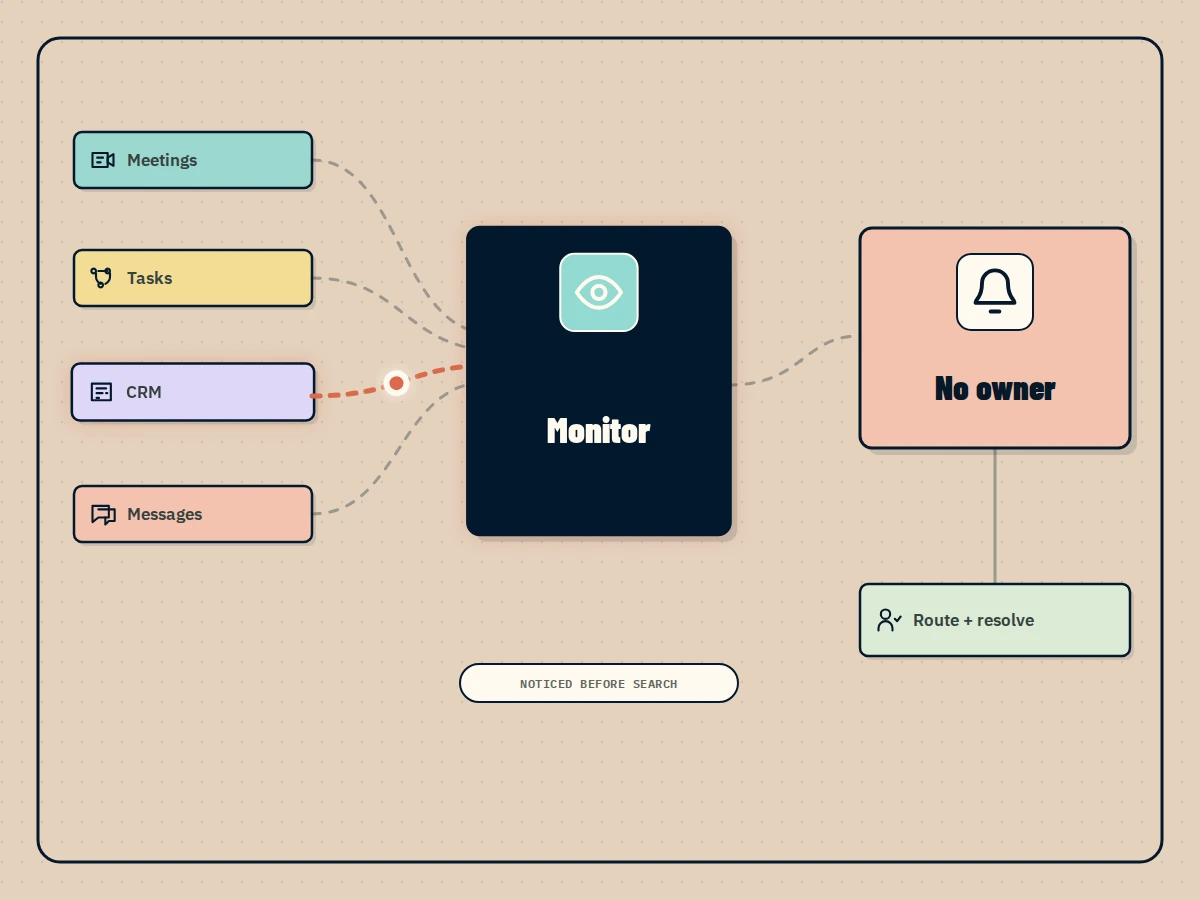
A search box waits for the right question.
Business problems often begin before anyone knows what to ask.
A client promise has no owner. A project has stopped moving. Two teams made conflicting decisions. A renewal date is approaching while the account plan remains incomplete.
The information exists. Nobody has searched for it because nobody knows the pattern is forming.
Search is reactive by design
Search is excellent when the employee can describe what they need.
“Find the current refund policy.”
“What did the customer say about the timeline?”
“Who owns the Acme account?”
The harder questions are about absence and change:
- Which important task has no owner?
- Which customer commitment never became work?
- Which project risk appeared across several meetings?
- Which decision keeps being reopened?
These questions require the system to compare events, expected states, deadlines, and responsibilities over time.
A brief should explain what changed
Many company reports repeat the current state.
A useful daily or weekly brief focuses on the difference:
- New decisions.
- Changed deadlines.
- Added or removed owners.
- Blockers that have persisted.
- Client requests that require action.
- Risks that crossed a defined threshold.
Each item should say why it matters, who owns the next step, and where the evidence came from.
Leadership should not receive a generated wall of text. The brief should help decide where attention is needed.
Begin with explicit signals
Do not ask the system to “find anything important.” Importance depends on the business.
Define a small set of signals first:
- A customer commitment without an owner after one business day.
- A high priority task overdue by more than two days.
- A project deadline changed without a recorded reason.
- A decision discussed in two meetings without resolution.
- A client risk mentioned repeatedly across approved channels.
These rules create a clear starting point. The company can later refine them using feedback.
Connect signals across tools
The useful pattern may not exist inside one application.
A meeting contains the commitment. Slack contains the internal concern. Asana has no matching task. The CRM still shows the old next step.
The signal appears only after those sources are connected.
This is where a Business Brain adds value beyond another dashboard. It links the customer, project, conversation, decision, and task before checking whether expected work exists.
Alerts need ownership
An alert without an owner becomes another notification.
Every proactive signal should route to a person or role that can decide what happens next. The system should also define escalation and closure.
For example:
- The account owner receives the missing commitment alert.
- If it remains unresolved for two days, the sales manager sees it in the brief.
- Once a task is created and linked, the signal closes.
This turns detection into an operating loop.
Control the noise early
Proactive systems fail when they report everything.
Employees learn to ignore repeated warnings. Leadership receives a long summary with no hierarchy. The system becomes an expensive notification feed.
Start with signals that can change a decision. Group related events. Set minimum thresholds. Record whether the recipient found the item useful. Review false positives and remove rules that do not help.
NIST’s guidance emphasizes ongoing monitoring and periodic review for deployed systems. The same discipline belongs in operational briefing. The rules must evolve as the company changes.
Preserve the evidence
A proactive brief should never require blind trust.
If it says a customer commitment is at risk, link to the meeting sentence, the current CRM record, and the missing or overdue task. If it says a decision is unresolved, show the discussions it compared.
The employee can verify the pattern quickly and correct it when the system is wrong.
Search and discovery work together
Search helps employees answer the question already in front of them.
Proactive discovery helps the company notice the question it has not asked yet.
A Business Brain should support both. Employees can ask for an answer, while leadership receives concise briefs about decisions, blockers, risks, and work that needs attention.
The most valuable answer is sometimes the one nobody knew to request.
Questions people ask
What is proactive business intelligence?
It is the scheduled or event based detection of relevant changes, risks, and exceptions before a person asks a question, followed by a concise alert or brief with evidence.
What should an executive daily brief include?
Include material decisions, blockers, client commitments, changed priorities, overdue actions, emerging risks, and items that require leadership attention.
How do you prevent business alerts from becoming noise?
Start with a small set of high consequence signals, define owners and thresholds, group related events, allow feedback, and remove alerts that do not change a decision.