Vacation is a business continuity test
If work stops when one employee is away, important context still belongs to that person instead of the company. Here is how to fix the handoff.
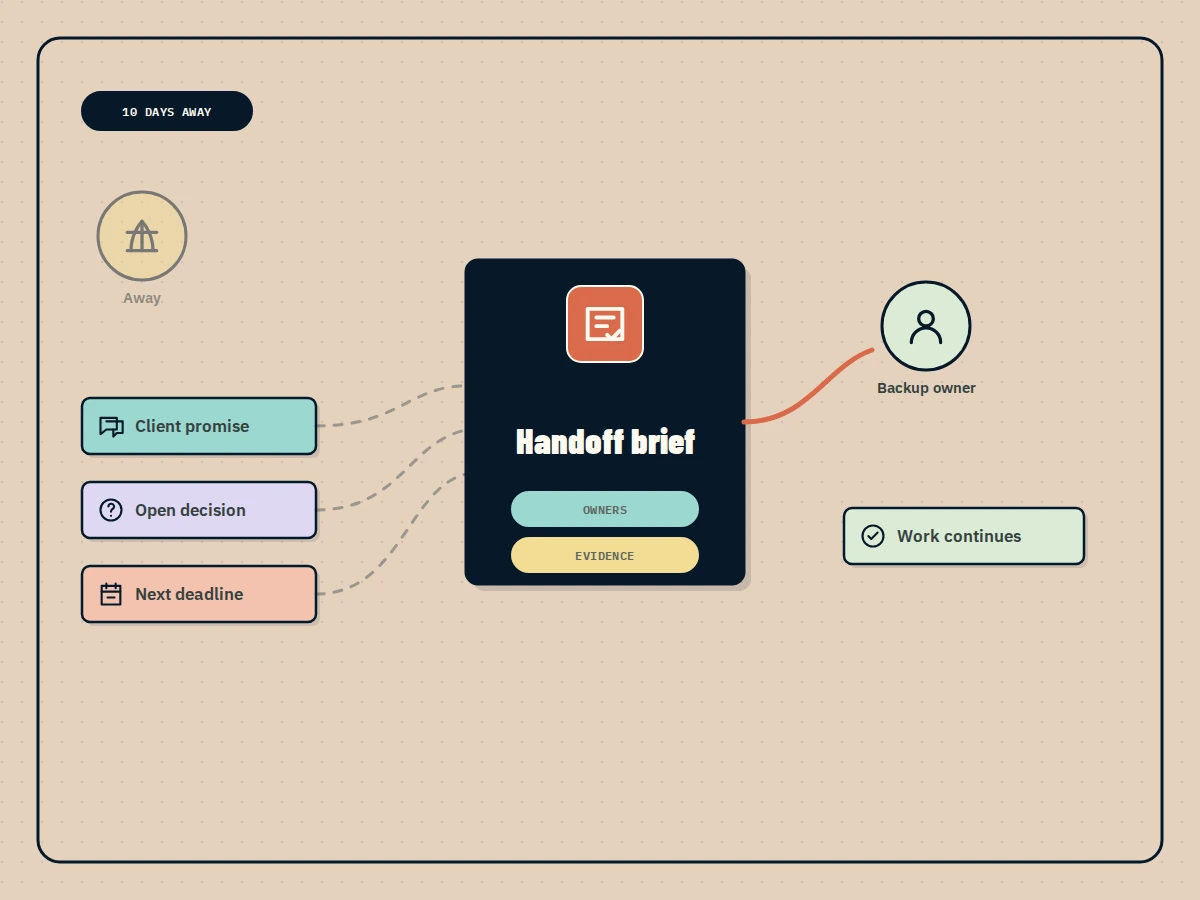
You learn a lot about a company when one experienced employee takes ten days off.
Projects either continue with a clear handoff, or the team waits, guesses, and sends messages to someone who is supposed to be resting.
The difference is not how hard that employee worked before leaving. It is whether their working context belongs to the company or remains trapped in personal memory.
The usual handoff is written too late
Many handoffs are prepared on the final afternoon before leave.
The employee opens a blank document and tries to reconstruct several months of work from memory. They list active projects, add a few deadlines, and mention the people who may need help.
This is better than nothing. It is also incomplete by design.
Decisions are scattered across meetings. Customer promises live in email. A task is blocked by a Slack conversation from last week. The project board shows what is open but not why it matters.
The employee cannot reliably remember every dependency under deadline pressure.
A handoff should come from the work itself
A useful handoff package can be assembled from the systems where work already happens.
For each active workstream, it should answer:
- What is the current state?
- What changed recently?
- Which decisions have already been made?
- What remains unresolved?
- Who owns each next action?
- What is likely to happen while the employee is away?
- Which source should the replacement open for more detail?
This is more useful than a long transcript or a list of links. The person covering the work needs a short operating picture with evidence behind it.
Find the work that has only one thread
Leave also reveals single person dependencies.
A project may have several people assigned while only one person understands the customer history. A recurring report may look documented while only one employee knows how to correct the data. A supplier relationship may have no shared record outside one inbox.
Before leave, ask a simple question:
Which work cannot move if this person is unavailable tomorrow?
The answer identifies where knowledge capture has the highest immediate value. It may lead to a backup owner, a short procedure, a shared credential process, or a connected source that makes the history visible.
Prepare for likely problems, not every possible problem
An effective handoff is selective.
It should surface the few issues most likely to require attention based on upcoming deadlines, unresolved threads, recent activity, and customer commitments.
For example:
- A contract renewal is due during the absence.
- A technical issue has no confirmed resolution.
- A client asked for an update by Friday.
- An approval has been waiting for four days.
Each item needs an owner and the relevant evidence. This turns a vague warning into work the team can continue.
The return brief matters too
The continuity problem does not end when the employee comes back.
They return to hundreds of messages and several meetings. Reading everything in order is slow, but skipping it creates mistakes.
A return brief should explain:
- What changed while they were away.
- Which decisions were made.
- Which work completed or stalled.
- Which commitments were added.
- What requires their attention now.
The brief should link to the original meeting, message, task, or record. The employee can verify the important parts without reconstructing ten days from a notification feed.
Continuity is an everyday practice
Government continuity guidance often focuses on serious disruptions and the unavailability of key staff. The principle is equally useful for normal business operations: essential work needs a way to transfer when the usual person cannot perform it.
The best time to build that capability is not during an emergency.
Capture decisions when they happen. Keep owners visible. Connect meetings to tasks. Preserve customer commitments. Make the source available to the people allowed to see it.
Then a handoff becomes a view of existing company context, not a last minute writing exercise.
Use the vacation test
Choose one important employee or role and imagine they are unavailable next week.
Can another person find the current state of the work? Can they see what has been promised? Can they identify the right owners and the decisions that shaped the plan? Can they continue without contacting the person who is away?
If not, you have found a practical starting point for the Business Brain.
A company does not truly retain knowledge until work can continue without the person who remembers it.
Questions people ask
What should an out of office handoff include?
A useful handoff includes current work, decisions already made, unresolved questions, upcoming commitments, likely risks, named owners, and links to the original records.
How can a company reduce dependence on one employee?
Capture decisions during normal work, keep ownership visible, connect project records with conversations and meetings, and regularly test whether another person can continue the work.
Can handoff briefs be generated automatically?
Yes, when the relevant sources are connected and permissions are respected. The brief should still link to evidence and allow the employee or manager to correct important gaps.