Live API calls are not enough for company knowledge
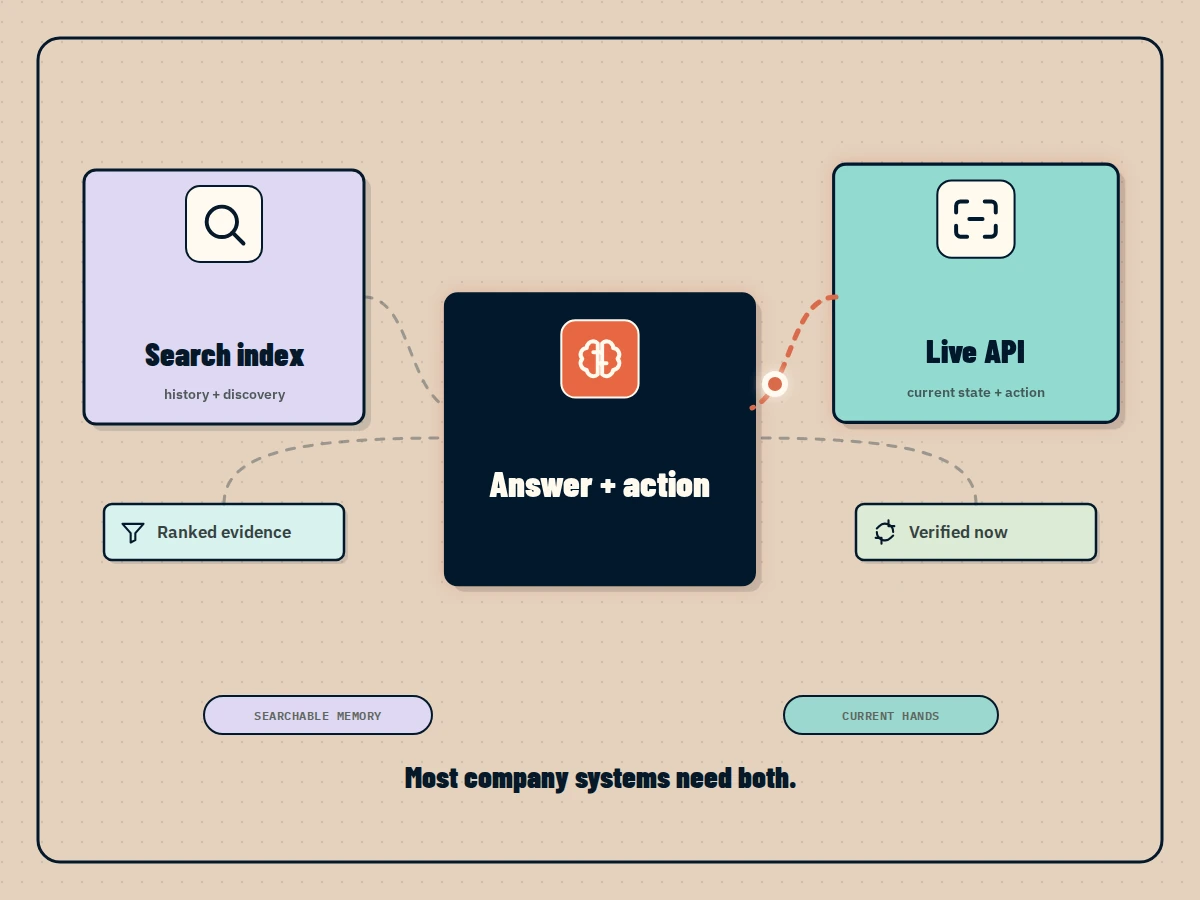
Direct tool calls provide current data. Indexed retrieval provides fast discovery and consistent ranking. Most Business Brain systems need both.
It sounds sensible to query every company tool live.
The answer is always current. There is no copied index to maintain. Claude calls Slack, Drive, CRM, and the project system when an employee asks a question.
Then the real questions arrive.
Search quality differs by tool. One API returns only exact matches. Another searches only the current user’s data. Results take several seconds. A meeting platform cannot search the transcript the way the team needs. The same customer appears under different identifiers.
Live access is important. It is not a complete retrieval strategy.
Live calls are best for current state and action
Some information changes too quickly to trust from a delayed copy.
Examples include:
- Current inventory.
- Appointment availability.
- Account balance.
- Active task owner.
- Latest opportunity stage.
- Whether an approval already happened.
The system should check these values directly before making a decision or taking an action.
Live APIs are also required to create a task, update a CRM field, send an approved message, or request an approval.
Indexes are built for discovery
A search index stores searchable representations of content with a defined schema. Microsoft notes that indexed content is kept apart from the original source partly to provide the response times expected from modern search.
An index can normalize content from several systems into common fields:
- Customer.
- Project.
- Owner.
- Source type.
- Created and updated dates.
- Approval status.
- Permission groups.
- Searchable text and vector representation.
That makes cross source retrieval and ranking more consistent.
Every source has a different search personality
A CRM API may filter structured fields well but search long notes poorly. Slack search understands messages and channels but not contract relationships. Drive can find documents but may not know which one controls the current customer agreement.
Calling all three produces several result lists with unrelated ranking scores.
An index can apply one retrieval strategy across normalized metadata, exact terms, and semantic similarity. It can connect a message and document to the same customer before the model sees them.
Exact and semantic retrieval work together
Company questions mix precise identifiers with natural language.
“Show the latest discussion about invoice INV-1048” needs the exact invoice number and conceptually related discussion.
Hybrid search combines keyword and vector search. Microsoft’s Azure AI Search runs both in parallel and merges their results. Keyword retrieval protects exact terms. Vector retrieval finds similar meaning even when the wording differs.
Filters then limit results to the correct client, date range, document type, or permission scope.
Indexing introduces a freshness obligation
An index can become stale. That tradeoff must be designed rather than ignored.
For each source, choose a synchronization approach:
- Event based updates for sensitive, rapidly changing records.
- Incremental scheduled updates for ordinary changes.
- Periodic full reconciliation to catch missed additions and deletions.
- Live verification before high consequence actions.
Microsoft Graph documentation describes event based, scheduled, incremental, and full crawl options for external content. The right interval depends on how quickly an outdated value could cause harm.
Permissions must be enforced in both paths
The indexed route and live route need the same access outcome.
If an employee cannot open a source document, the index should not return its content. If a live tool uses a service account, the workflow must still apply the employee’s access and purpose.
Security trimming after retrieval can leak sensitive information into the model’s input. Filter before the model receives the evidence.
Use a hybrid architecture
A practical Business Brain often follows this sequence:
- Search a permission aware index for relevant company history and evidence.
- Rank and assemble a small context set.
- Call the live source to confirm rapidly changing fields.
- Prepare an answer or proposed action with citations.
- Request approval when the action is sensitive.
- Execute through the live API and record the result.
This gives the system memory without treating yesterday’s copy as today’s truth.
Choose per question, not per platform
The same source may support both patterns.
Historical CRM notes can be indexed for discovery. The current opportunity stage can be checked live. Meeting transcripts can be indexed while a live meeting API schedules the follow up. Project history can support context while the active owner is verified before task creation.
The Business Brain should choose the right path for the decision, not force every source into one architecture.
Live APIs provide the current hands.
Indexes provide the searchable memory.
A company system usually needs both.
Questions people ask
Should a Business Brain query every source live?
Not always. Live calls are useful for rapidly changing state and actions, while an index is better for fast search, ranking, cross source discovery, and historical context.
What information should remain live?
Inventory, current ownership, active balances, appointment availability, and other rapidly changing values often need a live confirmation before an answer or action.
What information should be indexed?
Documents, meeting knowledge, messages, historical decisions, and searchable records often benefit from permission aware indexing with metadata and scheduled or event based synchronization.