MCP connects tools, not understanding
What the Model Context Protocol solves, what it does not solve, and what companies still need before Claude can work safely across business systems.
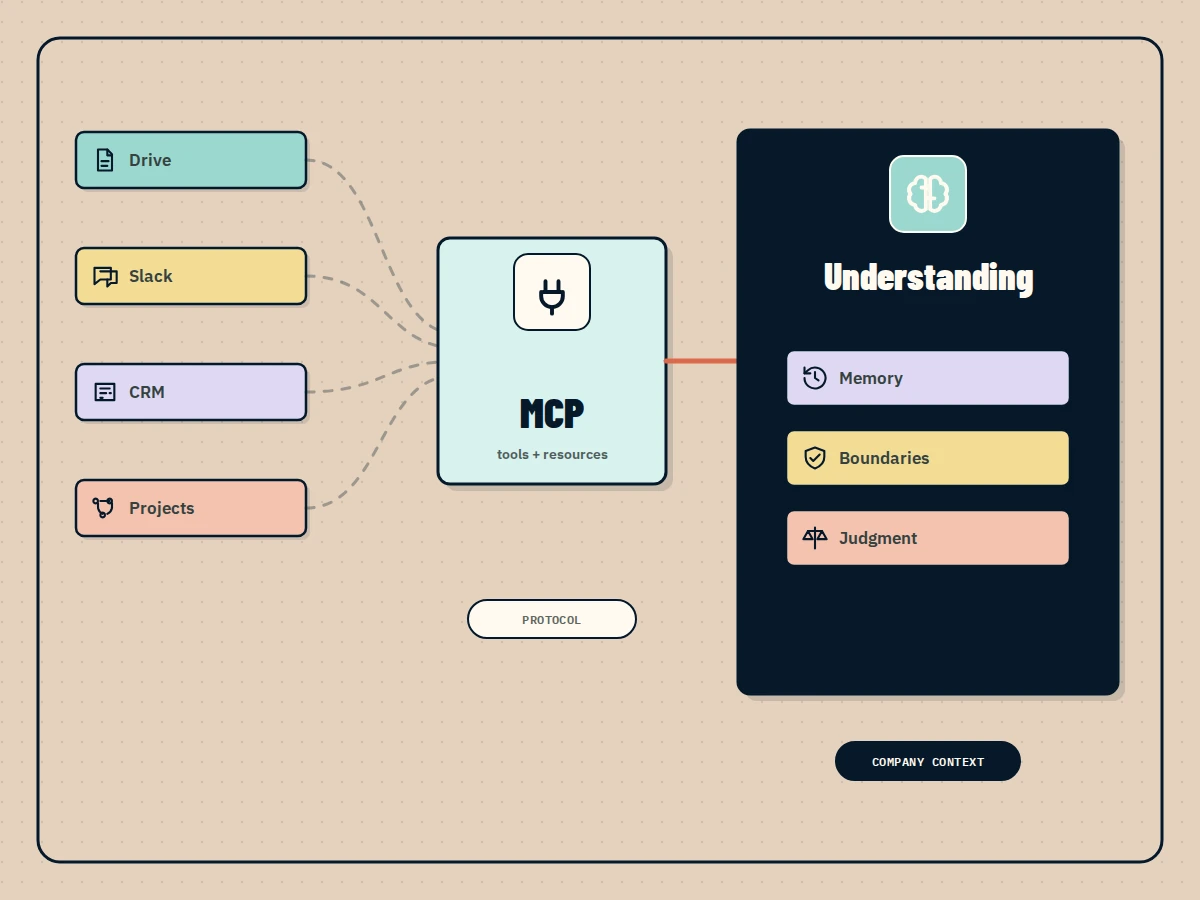
MCP makes an important part of connected work easier.
Instead of building a different custom interface for every application, a system can use a common protocol to discover tools, read resources, and execute supported actions.
That is useful infrastructure.
It does not mean the model understands your company.
What MCP solves
The Model Context Protocol defines a standard way for an application to interact with external capabilities.
An MCP server may expose:
- Resources that provide data or context.
- Tools that perform actions.
- Prompt templates for supported workflows.
For a company, this could mean Claude can search a project system, create a CRM task, check an inventory record, or retrieve an approved document through compatible servers.
The value is interoperability. The client and server agree on how capabilities are described and called.
What MCP does not decide
The protocol does not know which source is authoritative for your pricing policy.
It does not know that a Slack user and a CRM owner are the same employee. It does not decide whether a contractor may see a client folder. It does not automatically rank a current signed agreement above an old proposal.
Those are company context decisions.
MCP can expose the search tools. Something still needs to decide which tools to use, how to combine their results, and whether the answer is safe to show.
Tool access can increase ambiguity
Imagine Claude has access to four tools:
- Search Google Drive.
- Search Slack.
- Read CRM records.
- Read meeting notes.
An employee asks, “What did we agree with this customer?”
Each tool may return relevant material. Drive has the contract. Slack has an internal discussion. The CRM has a summary. The meeting contains a later verbal commitment.
The connection problem is solved. The interpretation problem remains.
The system needs to know which commitments are approved, which employee is asking, whether the meeting was shared, and how to present conflicting evidence.
Authorization must be designed deliberately
The MCP specification includes authorization mechanisms for HTTP based servers and builds on OAuth. Its security guidance emphasizes consent, access controls, privacy, and caution around tools that can execute code or change systems.
The practical design should follow least privilege.
A reporting assistant may need permission to read opportunities but not edit them. A sales manager may approve a discount while a salesperson can only request it. A support workflow may create a draft response but require a person to send it.
Do not give every connected assistant one broad service account. Connect actions to a user or controlled service identity, request only required scopes, and validate authorization at the server.
Retrieval needs a layer above the tools
Calling every search tool for every question is slow and noisy.
One source may use keywords. Another may support semantic search. A third may return only the current user’s records. Results have different formats and relevance scores.
A governed retrieval layer can normalize identities and metadata, preserve source permissions, and create a consistent ranking strategy. It can retrieve likely evidence first, then use a live tool call when the current state needs confirmation.
This reduces the amount of irrelevant material sent to the model and makes answers easier to evaluate.
Actions need business rules
MCP tools can make actions available. The company still defines when those actions are appropriate.
Consider “update the opportunity and email the customer.”
Before execution, the system may need to check:
- Does the employee own the opportunity?
- Is the proposed stage transition valid?
- Was the email generated from approved facts?
- Does an external message require review?
- Should the CRM update happen before or after approval?
- What should be logged?
The tool call is one line in the workflow. The business rules make it safe.
A practical architecture
For most companies, MCP fits into a larger design:
- Identity and access. Know which person or service is making the request.
- Context and retrieval. Select relevant, current, permitted evidence.
- Reasoning. Let the model understand the request and plan the next step.
- Tools. Use MCP or direct APIs to read current state and propose actions.
- Approvals. Pause sensitive actions for a person or policy check.
- Logs and evaluation. Record what happened and test whether the workflow remains reliable.
MCP improves step four and can support step two. It does not replace the others.
Use MCP for what it is good at
MCP is a strong foundation for making company tools available through Claude without inventing a new integration pattern every time.
Treating it as the entire knowledge architecture creates false confidence.
The Business Brain uses tool connections as part of a wider system with source backed answers, permissions, approval rules, and maintained company context.
The protocol gives Claude hands. The company still needs to provide memory, boundaries, and judgment about how the work should move.
Questions people ask
What is MCP in simple terms?
The Model Context Protocol is a standard way for applications such as Claude to discover and use external tools, resources, and structured workflows.
Does MCP give Claude access to all company data?
No. Access depends on which servers are connected, which capabilities they expose, and how authorization is configured. The company must still enforce identities, permissions, and consent.
Is MCP the same as a Business Brain?
No. MCP can provide the connection surface. A Business Brain also needs trusted retrieval, company identity mapping, permission rules, source authority, memory, logging, and workflow approvals.